Feature Photo: romana klee Photo: tore_urnes
Confusion over the linguistic heritage of Urdu is evident in the comment section of our recent article about the world’s most beautiful languages. While more than one person remarked that the Urdu language is poetic, nobody could agree on where it came from. Matador intern Neha suggested it shared roots with Farsi, while blogger Ameya said that “it’s pretty much the same language” as Hindi. A third person, calling himself or herself the “Indo-Euro language expert” disagreed saying, “Urdu isn’t the same as Hindi…Urdu is in fact almost a mix of Hindi/Farsi.” The Urdu Language website claims, “Urdu vocabulary contains approximately 70% Farsi and the rest being a mix of Arabic and Turkish.”
So who’s right? Where does Urdu come from and what other languages is it related to? Languages cannot be “conglomerations.” When linguists describe language groups, they talk about language trees. Every language has roots. It has sister branches with which it shares common ancestors, and just because it absorbs some vocabulary from another language doesn’t mean that its fundamental structure is changed. For example, our use of Japanese words like “sushi” and “karaoke” doesn’t mean that English is closely related to Japanese.
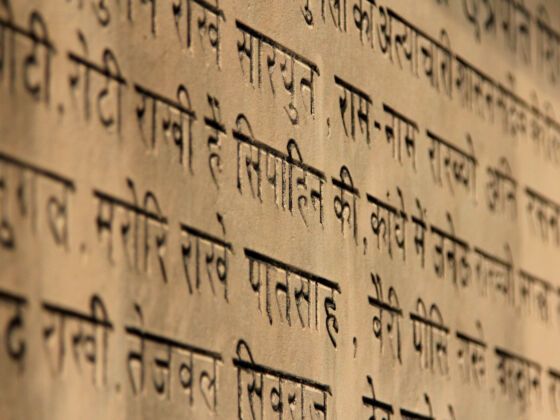
Hindi script, Photo: tanvi_s19in
Languages and Dialects
Urdu is technically classified as an Indo-European language on the Western Hindi branch of the language tree. It does not only share roots with Hindi, but linguists actually classify Hindi-Urdu as one language with four distinct dialects: Hindi, Urdu, Dakhini (spoken in northern India) and Rekhta (used in Urdu poetry).
Dialects differ from each other in the same way languages do: syntax (structure), phonetics (sounds), phonology (systems of sound changes), morphology (systems of grammatical changes) and semantics (meaning). Two ways of speaking diverge into two different languages due to the degree of difference rather than the types of differences.
Think about American English and British English, or even different dialects of English within your own country. Speakers may use slightly different grammatical structures, sound a bit different, and sometimes use different words to mean certain things, but they can still understand each other most of the time. Two ways of speaking are said to be two dialects of the same language when there is mutual intelligibility, meaning that the two speakers can understand each other.
I’ve crossed the Indo-Pak border multiple times, and as long as I remember to swap Salaam alaikum for Namaste when greeting people and shukriya for dhanyabad when thanking people, nobody in India ever questioned my Hindi. At the intermediate level, I experienced 100% mutual intelligibility. I could understand Hindi speakers, and they could understand me. Most people in India asked me where I had learned Hindi, and when I responded that I had studied Urdu in Pakistan they were surprised.
Languages and Political-Cultural Identity
Hindi and Urdu both originated in Delhi and have roots in Sanskrit. After the Muslim conquest by Central Asian invaders in the 11th and 12th centuries, the new rulers learned the local tongue. These rulers spoke Persian and Turkish and wrote their languages in the Arabic Nastaliq script, so when they started speaking Hindi-Urdu they wrote this new language in the Nastaliq script as well. By the 16th century, it had developed into a dialect of its own termed Urdu with a prominent literary culture revolving around the royal court.
Because it was used by Muslim rulers and became largely used by the Muslim population, a number of Farsi, Turkish and Arabic loan words made their way into Urdu. Hindi, on the other hand, retained its religious and formal vocabulary from Sanskrit and utilized the traditional Devanagari script. Nowadays, a Muslim Urdu-speaking imam and a Hindu priest may have difficulty discussing deep theological topics with one another due to these differences in vocabulary, but for normal conversations they would be able to understand each other just fine.
Pakistani border guard, Photo: tore_urnes
Why are some people so insistent that Urdu and Hindi are different languages? And why have people in Pakistan and INdia been brought up to think that way? Language and culture are so intertwined that people groups often use language to define themselves. In Pakistan, the myth that Urdu comes from Arabic, Farsi and Turkish is prevalent, and bogus claims like Urdu vocabulary being “70% Farsi” are common.
I’ve talked with dozens of Pakistanis about Urdu and Hindi, and many insist that Urdu has more in common with Persian and Arabic than it does with Hindi. When I ask them how they can understand Bollywood films and Indian TV, I’m usually just told that it’s because they “watch it a lot” and hence have “learned Hindi.” Objective analysis seems a casualty to the desire for a strong political, social and cultural identity as a separate, Muslim nation.
From a linguistic standpoint, the idea that Urdu is more closely related to Arabic than Hindi is simply ridiculous. Urdu is more closely related to English, French or even Welsh than it is with Arabic, and Urdu itself is only the native language of about 10% of the Pakistani population. Most families who speak Urdu as their first language emigrated from India during the 1947 partition.
Over 60 languages are spoken throughout Pakistan, and over 400 languages are spoken in India. Many of these languages form what linguists called a dialect continuum, a group of dialects or languages that gradually fade from one to the next across geographic areas. Arabic is also technically a continuum of several languages and sub dialects that differ progressively from each other. While a Jordanian person and a Lebanese person may understand each other just fine, an Egyptian will have much more trouble understanding a Moroccan because these “dialects” of Arabic are not mutually intelligible and are so different from each other they are classified as different languages.
Due to a shared cultural, historical and religious heritage, Arabic is considered as one language by many of its speakers even though they may not be able to understand the several different varieties of Arabic throughout the region. All these “Arabics” do share a common linguistic ancestor, but they have differed so much from each other over the centuries that it’s more the notion of Arab unity that continues to bind these languages than the similarities between them.
Similarly, in South Asia it is more the idea that Urdu and Hindi are different languages that represent different cultures that prevails over their linguistic similarities as sister dialects. We often choose to believe and promote what makes sense in our worldview, and when people come in and question the way we define ourselves or our culture we aren’t very likely to change the way we think about things.
Do you know of any other situations where dialects are considered separate languages or several languages are considered to be dialects of one language? Share in the comments section.
Community Connection
Traveling to India or Pakistan? Find out why you should learn Hindi-Urdu and What Not to Do in Pakistan.
About the Author
Related Posts
34 Comments... join the discussion!
-
-
In Turkey, I worked for a while with a British Pakistani fellow and we had a lot of conversations about language. Urdu’s complex origins came up often, as we were both also studying Turkish and we’d noted so many shared words (mostly Arabic or Farsi in origin, but not all and still understandable to a Turkish speaker) . In Turkish, ‘ordu’ is ‘army camp’ and he surmised that Urdu may have evolved through generations of interminglings between the Persians, Hindus, Turks and their various military alliances.
↵ -
You got in Maryanne, “Urdu” the word comes from the Turkish for “army encampment,” and this is because it was the military forces surrounding Delhi that primarily used the dialect (in addition to the court and the poets) under Muslim rule in India.
↵ -
When I ask them how they can understand Bollywood films and Indian TV, I’m usually just told that it’s because they “watch it a lot” and hence have “learned Hindi.”
well, whoever told you , they were wrong, we understand them because they speak mostly urdu , not hindi in their movies to grab the share of pakistani market.
i remember in india they had a huge discussion over this part , that they should use hindi in movies but that will bring down the business because no pakistani understands hindi.the only similarity between urdu and hindi is the use of verbs like “is” , “are” , etc that’s it , not even a single word in urdu and hindi is common except for verbs.
no urdu speaker understands hindi , if they speak pure hindi, but most of hindi speakers are used to use urdu words because of movies. you will never find those words in hindi books.except for verbs , urdu is mixture of farsi, arabi and about turkish i am not sure.
all the basic words of urdu came from farsi and arabi. that is why we can easily learn urdu and farsi.let me now introduce myself,i am pakistani, pushtoon.
my mother language is pushto(khattak pushto, a very different dialect than genral known pushto)
my national language is Urdu, and i had my basic education in urdu language upto 10th grade.
i know arabi because i have been in arab country for 16 years and also it is related to us by our religion islam.
i know a little bit of farsi because many farsi speakers live in our province migrated from afghanistan.so i know these languages with grammar.(except farsi)
hindi is known to us only by bollywood movies and that is the basic reason why every one is confused about hindi and urdu similarities.
↵ -
Sorry Muhammad but you are choosing to believe the myth. I’ve studied Arabic as well so I can offer these comparisons. Take a basic greeting.
English: Hello, my name is Heather. I speak English. I am from America. What is your name?
Arabic: Ana ismi Heather. Adrusu al lugha al Ingliziyya. Ana min Amrika. Ma ismu-ka?
Urdu: Mera nam Heather hai. Mai Angrezi bolti hu. Mai Amerika se hu. Aap ka nam kya hai?
Hindi: Mera nam Heather hai. Mai Angrezi bolti hu. Mai Amerika se hu. Aap ka nam kya hai?
You said that “only the verbs” are the same. Well in these sentences, every single thing between Urdu and Hindi is the same. Possessive pronouns, nouns, verbs, helping verbs, postpositions, question words….
In Arabic, the word order and the structure is completely different from Hindi-Urdu.
↵ -
you haven’t studied arabi very well i suppose,
“I speak English” translates to ” atakallamu anglezi”
while “Adrusu al lugha al Ingliziyya” is transation for “i teach english language”i dont know hindi that much so i cant say what exactly in hindi it would be.
but that’s not pure Hindi, it’s again Urdu as i said before hindu will say that and understand but that is urdu not hindi, just because they use it in their movies and dramas, if you happen to listen to hindi news channel, you won’t catch anything but mostly verbs that would resemble urdu.
i do not understand indian news cahnnel, why? because they don’t mix urdu and hindi, they speak pure hindi, while i have no problem in understandng bollywood movies.and you cannot compare them with basic greeting message,specially when you don’t know these languages from the root.
lets compare them from another angle, i agree that urdu and hindi have same structure of words but vocabulary is totally different:
ilm (knowledge) is word from arabi used in same meanings in farsi, urdu and also pushto but you will also hear it in hindi
for example:english: knowledge is good
arabi: ilmun jayyad
urdu: ilm acha hai
hindi: ilm acha haiyou will often hear it the same way in hindi movies but thats not hindi in pure hindi it translates to
giyan acha hai ( here again even word “acha” is used from urdu , i don’t know what is it in hindi, so i just used it)
ilm word is coming from arabi, and of course hindi is not influenced by arabi but urdu is, so in hindi the word for knowledge is giayn , which means when in hindi you hear word “ilm” thats coming from urdu.
there are countless examples like that for instance:
english : school
arabi : madrasa (root word is daras means teaching)
farsi : daras gah or madrasa( still root word is daras)
urdu: daras gah or madrasa(still root word is daras) even it is the same in pushto
hindi : patshala (totally different)english: question
arabi: sua’al( root word is sa’l)
farsi: sawal( coming form sa’l)
urdu: sawal
hindi: pratigyabut again they also use word “sawal” but that’s not hindi , they are just using word from urdu or farsi, you wont find this word in their books or even in news channel, they would use word pratigya.
bottom line is urdu and hindi have same word order and structure but the vocabulary is totally from different roots,urdu draws vocabulary more heavily from Persian and Arabic, while Hindi draws vocabulary from Sanskrit more heavily.
they might look very similar but only from movies, never from books and novels etcIn India, Urdu retains its stronghold in the cities of Lucknow, Aligarh and Hyderabad, and in the states of Jammu and Kashmir and Andhra Pradesh. However, few Hindi speakers in other states in modern India can write and read in Urdu.that is why bollywood is mixing urdu and hindi to let every one uderstand, and that is giving illusion of urdu and hindi being same language to the outer world
one cannot says that these both are one and same because of their same structure or other similarities while having a totally different vocabulary.
↵ -
I only know some Hindi, and I can rarely tell the difference when someone is speaking to me in Hindi or Urdu, because they are basically the same on a convorsational level.
Higher level, which many news casts might be in, then yes, the fancy words are different. Luckily I have yet to talk to anyone who bothers speaking in “pure” Hindi or Urdu. :p
↵ -
Wow. Really interesting! I always thought it was a bit strange that people say “speak Arabic”. I never knew that about Urdu and Hindi and it looks like you’ve ruffled some feathers.
It’s also interesting how some foreign accents in Spanish can be so difficult to understand, even for native speakers. I guess if you speak slowly enough it all works out and the ’sameness’ becomes evident enough.
↵ -
Interesting! I didn’t know that.
↵ -
oops this was too Maryanne above.
↵ -
It’s funny, I study Hindi (though my Mandarin gets in the way and I don’t even like it as much!) and I never knew that people were like this about them! I can understand Urdu most of the time (basic, of course) so It definitely hurts my brain that people fight about it.
Like an above poster said, Chinese is crazy, written it is the same, but spoken it’s very different, talk about strange!
↵ -
Even though not in a position to offer a complete analysis to prove whether they are the same or not, but what I can say is that when a Hindi speaker chooses to express himself or herself purely in Hindi, then as a resident of Pakistan and an Urdu speaker I can say that I fail to understand a single word being spoken. The example would be many episodes of the Indian version of Who Wants To Be a Millionaire. When they adopted a more Hindi oriented approach to the question and answer sessions, I was rarely able to understand a single word being spoken. That aside, the reason why Pakistanis are able to understand most of the Indian films is that they are intended to be inclusive rather than exclusive and it is achieved by using a language which is understood by people across borders and that happens to be Urdu and not the pure Hindi.
↵ -
People often trot out the example of Chinese and how we pretend that it’s a language with dialects, when in fact there is a set of languages spoken in China, whereas we say that Norweigan and Swedish are their own languages althought hey are highly mutually intelligible (and to a lesser extent, with Icelandic), so I suppose that’s worth mentioning.
It’s all a giant game of language meets politics and identity, I suppose. As a child I was told that Yiddish was not really related to German, which fails to explain how, after growing up with about 500 words of Yiddish frequently spoken near me, I can understand some simple German conversations.
Great piece, and nice discussion!
↵ -
It’s so weird, just last night I was trying to explain to a Croatian friend, how I understood Urdu, spoken by a Pakistani friend, when I don’t actually speak it. And how he understands us (me and my husband) when we speak in Hindi. I didn’t know the two are considered one. I’ve always thought they were two different languages with a lot of common ground.
And while I don’t agree with a lot of the us verses them arguments here, I have to say conversational Hindi today is filtered with other languages. Not just Urdu though – we use a lot of English and regional language words too. But more than some crazy capitalist Bollywood ploy, I think that’s just an example of how language works. It soaks in some words, it prunes out others.
If you hear me (or anyone from my part of India) speak Hindi, it’s peppered with English and Marathi (my mother tongue) words. Most native Hindi speakers find it very funny. For example in Mumbai it’s batata and kanda – not aloo and pyaaz.
The shudh Hindi I learned in school is a little harder to follow. It is also a very formal way of speaking – used in speeches, formal conversation and in formal writing. But that’s true of any language, right? I don’t think too many people speak in pure formal English either.
Thanks for this piece Heather. Really enjoyed it.
↵ -
An interesting post Heather, and I enjoyed going through the comments as well. Now, let me share my two cents worth:
In Bollywood films, the language used is “Hindustani” – a phonetic mixture of Hindi and Urdu. I believe that is done so for wider publicity of the film, particularly so the people across the border can understand the language.
Secondly, the reason Urdu speaking people claim Urdu is closer to Arabic than Hindi is because of its script. Scriptwise, the closest resemblance of Urdu is to Arabic. Phonetically, to Hindi.
I can read, write and speak Hindi and Arabic, and because of the knowledge of these two, I can fairly read, write and manage a conversation in Urdu too though I’ve not studied the Urdu language.
I can read, write and speak 4 other languages as well but then that’s a different thing altogether. Have a nice day!
↵ -
Pakistan’s national anthem hasn’t a single word of Urdu it is all in Persian still every Pakistani understand it because same words are used in urdu.
Persian remained official language of India for centuries and it was more of language of elite and ruling class. Many poets of urdu did poetry in Persian as well.
I think urdu and hindi are same language with little bit difference of few words.
↵ -
This is one of the most interesting articles – and discussions – I’ve read in a long time
↵ -
wow, nice comments, i must look back too frequently ,this is not my favorite topic and i do not like it but after observing that more people are interested i want to add more…
now i agree more with you Miss Heather but still it is not clear though, because many relate urdu with punjabi , punjabi and urdu are also closely related and both speakers could understand each other without much difficulties.
and also maybe hindi/urdu were same language long time ago, but aren’t they different today due to cultural differences, religious, geographical and poitical reasons, i mean how languages evolve from each other?
have a look at folowing linked article
http://www.pakspectator.com/origin-of-urdu-language/
you said “the way we would speak with the president is very different from how we’d argue with our spouse”
this again makes me think about how languages differ,
we do speak different while we are with president than arguing with spouse but still it would be the same language right? but in case of urdu/hindi only arguing the spouse makes it look similar languages while if urdu speaker would talk to urdu speaking president will be way more different than a hindi speaker talking to hindi speaker president and hardly both speakers would understand if both tred to speak the same way with each other, isn’t this making them different languages?i would like to hear more from you.
↵ -
What about Nepali?
Is it simply “bad Hindi” as many Indians claim, or a dialect in its own right?
↵ -
“Taiwanese” in Taiwan (a.k.a. Holo or Banlamese), “Banlamese” in China’s southern Hokkien province, “Haklau” in China just east of Hong Kong, and “Hokkien” in Malaysia, Singapore, Indonesia, Myanmar and the Philippines are basically the same language, but some don’t and won’t know it. The Taiwanese are the extreme example. Some Taiwanese say that their version of the language is a different language because of limited loans from Japanese. In general, speakers in Hokkien province and Taiwan “refuse to understand” unfamiliar dialects–switching to Mandarin in order to communicate–while speakers in Guangdong and the Malay/Nusantara countries are comfortable with dialect differences.
↵ -
Hi Heather–
Actually, I was only talking about “Min Nan” (Banlamese) as spoken in different areas. Holo-Banlamese is “one language” when we go by the mutual intelligibility criteria. People’s real and perceived inability to communicate with people speaking other dialects of Banlamese … is probably a matter of exposure and propaganda.
Mandarin is a whole other issue, a drastically different language. There is next to no mutual intelligibility there, by the way. Mandarin and Holo-Banlamese are about as far from each other as mainstream Sinitic languages get.
From a historical POV, I think the relationship between Mandarin and Holo-Banlamese is similar to the relationship between Vietnamese and either of the two. But there are ways to justify drawing the line where it’s drawn now.
Interesting thread. Looks like people are working off different definitions of “Hindi” and “Urdu”.
↵ -
Actually, pure Hindi was derived from Sanskrit; and Urdu was derived from Persian, Arabic, Turkish and some Sanskrit. This is not an easy topic to answer, but Urdu has been prevalent in the Indian subcontinent since Mahmoud Ghaznavi’s (and also the Mughals, who had a Turkish background) time, the first Muslim to invade the Indian subcontinent. At that time, Urdu used to play second fiddle to Farsi (Persian) in the courts. Urdu slowly started to displace Farsi in the courts, and became the most prominent language in the Indian sub-continent. Urdu underwent a lot of structure, a lot of developments in India through poetry (mushairas), books; in places like Delhi and Lucknow. Urdu is one of the most well-structured languages, because time and effort was made on it to make it like that over the centuries. There are a lot of things you can say in Urdu, that are IMPOSSIBLE to translate in English because it cannot grasp it.
Pure Hindi has been derived from Sanskrit, one of the oldest languages in India (Sanskrit, along with Telugu and Tamil being the oldest ones I believe). But Sanskrit has been undergoing a demise, because not a lot of work has been done on it over centuries. Hence, Hindi has been undergoing a similar demise. These days, besides Hindu political parties and certain religious leaders, NO ONE speaks Hindi. They like to call what they say ‘Hindustani’ (a mixture of Urdu and Hindi, with Urdu being the major part). I agree with Mohammad Moosa: what you see most Indians speak, and what is spoken in Bollywood is actually Urdu with a Hindi accent.
How can I say that? Listen to the words they say: they are Persian and Arabic derived words, not Sanskrit. Even Indians themselves do not have any knowledge of Sanskrit based terms. All the dialogs, and lyrics of songs are actually Urdu, but they are given the name of Hindi because of the Hindu-Muslim divide. Hindi was never formally a part of sub-continent India, but was made the national language of India only in 1947, and an effort was made to instill words of Sanskrit origin to make Hindi different from Urdu. It was taught in schools like that, but a language needs to evolve over a period of time like Urdu did, not forcefully implemented. I can easily vouch that 95% of spoken Hindustani is actually Urdu, 5% is Hindi.
↵


