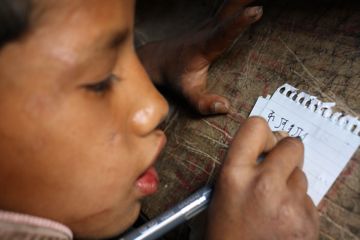
Useful Nepali Phrases to Know Before You Visit Nepal

08/3/09  Print This Post Print This Post    13 Comments   Popular   Written by Sarah Vazquez
    Share

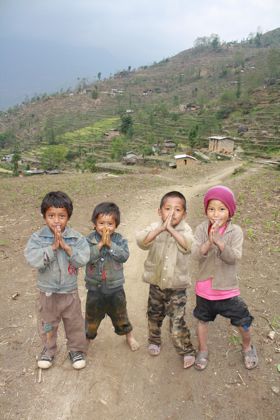
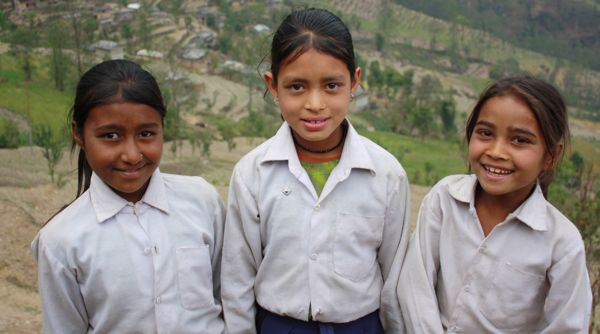
Chaukati schoolgirls. All photos by Sarah Vazquez

Learning a foreign language, although difficult and discouraging at times, increases the caliber of your travels exponentially.

If you are headed to Nepal, take note of these quintessential keywords. Remember, you are not aiming for fluency; you are aiming for safe water, a settled stomach and happy hosts.
1) Namaste vs Tik Chha

Let’s start with your first word, namaste.

This is used as both a greeting and a goodbye and is accompanied by holding your palms together in a prayer position. When you meet people, say “namaste,” and hold your hands together in front of you.

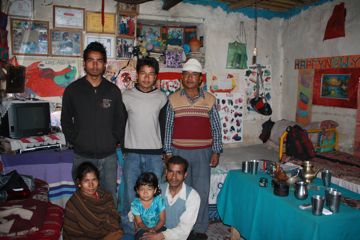
A family poses for a photo after hosting me for chiyaa.

Strangers, shopkeepers, fruit venders, farmers, bus drivers, and policemen will all appreciate your courtesy.

Be careful not to be overzealous with your namastes; you do not need to say namaste to people more than once in the day.

Do not say namaste to your hostel owner every time you walk to your room. Using namaste properly will make you a language connoisseur, not a language kook.

Instead of namaste, you can casually say, Tik chha?

When you say Tik chha? as a question, it is an inquiry, “Are you okay? How are you? How are things? How is the day?”

When you say it in response to a question or in the context of a conversation, it means general satisfaction, “I am well. This tea is good. This shawl is good for me. Today is a good day.”

2) Diddi, Dai, Bai and Bahini

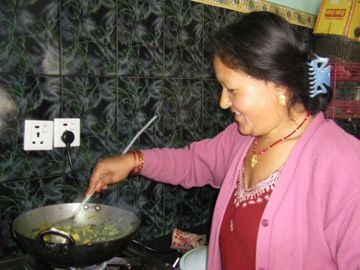
A typical Saturday morning activity.

Family is very important in Nepal. It is not uncommon for the first question from a street vender to be, “Do you want fruit?” and the second question to be, “How is your mother?”

In Nepali, people often address each other by an affectionate, familial nickname, such as: Diddi (older sister), dai (older brother), bai (younger brother), or bahini (younger sister).

Often times one of these nicknames will be used after a name to add respect and formality. If I were talking to my teacher, Sweta Gurung, instead of saying, “Namaste Ms. Gurung,” I would say, “Namaste Sweta Diddi.”

These nicknames are also an endearing sign of friendliness. Next time you go get a cup of chiyaa try saying, “Namaste, Diddi,” when you order.

If you yourself are called any of these nicknames, rest easy knowing that it is a compliment and shows that you are liked.

3) Kanna, Chiyaa, Piro, Umaleko

“Ramro kanaa!”

Along with family, food is also sacred; good food is a sign of a good host.

Kanna: “food.”

If a friend, or even a stranger, is talking to you, then any sentence with kanna in it is a good thing and usually means you are being invited to eat.

If you have not eaten when you arrive at someone’s house, it is usually an unacceptable way to continue with the day. You will be fed.

Piro: “spicy,” or, “hot.”

Simply ask, “Piro?”

No matter what you think of your spice tolerance level, Nepal has spice like you’ve never tasted before. Do not underestimate the chilies or the cooking.

If your host says it’s piro, then it’s Nepali hot. Proceed with caution.

Chiyaa: “tea.”

Like kanna, chiyaa is always a good thing. It is very safe to say that if you arrive in any store, home or office at the right time of day (any time of day) then you will be offered a cup of chiyaa.

It would be incredibly rude to not offer a guest chiyaa, and doubly rude to not offer a foreign guest chiyaa.

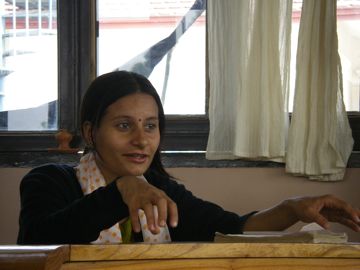
The Nepali guru herself, Manju Diddi.

Likewise, it is rude for you to not accept. It doesn’t matter if you don’t want a cup and it doesn’t matter if you have somewhere to be.

Try your hardest to accept a chiyaa invitation; accepting hospitality is the best way to repay hospitality. Usually, chiyaa implies, dude chiyaa (milk tea). You can ask for calo chiyaa if you don’t like milk and this will get you plain black tea. There is always a hefty amount of sugar included.

Umaleko paani/filter-ko paani: “boiled water/filter water.”

Tap water is not safe to drink in Nepal. Simply ask “Umaleko paani?” or “Filter-ko paani?”

It’s worth asking at least twice, because you need clean water to be a steadfast rule of your eating habits.

Ramro: “Great. Good. Beautiful. Enjoyable. Pretty. Excellent. Tasty.”

Ramro can mean any and all positive adjectives. Use it to describe, review or request any food, clothing, housing, tea, adventure, or person. For example:

“How is your mother?”
“Ramro!”

“How was the chiyaa?”
“Ekdahm (very) ramro!”

Parchha/pardina: “I need/I don’t need.”

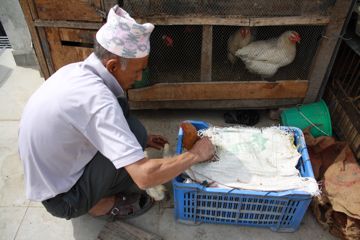
Many Nepalis have their own chickens so that they can eat fresh eggs everyday.

This is a very useful phrase. Put a noun in front of parchha and you almost have a full sentence! For example:

“Ma umaleko paani parchha (I need boiled water).”

You can use pardina with the same structure. However, if you are being pestered to buy, eat or accept something, you can simply say, “Pardina, Dai,” and this should tell your annoyer that you “don’t need it.”

This technique is handy in shops and on the street.

Homework garchuu:

Garchhu comes from the verb garnu (to do).

In Nepal education is taken very seriously and children are always doing homework. If you are a young traveler and find that you need to take a break from your hosts, you can simply say “Ma homework garchhu.”

Although you may think this is a nerdy excuse, it is the closest excuse that can get you out of a three hour long dinner conversation (which you can’t understand) and having to eat third helpings of daal bhat.

Pugyo: “Full.”

This is possibly the most useful phrase you will need to know. It is very rude for a Nepali host to leave their guest with an empty stomach.

When you are in a home and sit down for a meal, your plate will be overloaded with filling carbohydrates and there will certainly be seconds for you to eat. Before touching your food, separate the plate in two portions and say, with your extensive vocabulary,

“Pardina, Diddi.”

Make sure to smile. As long as you haven’t touched the food, your host can take it back and hopefully you have not offended her.

When she comes around to give you a second helping and you are already full (you will be full), hold your plate back and say with a big smile:

“Pugyo, Diddi.”

Namaste!

To be safe, hold a hand over your plate so she doesn’t dump food on it anyway.

A few belly rubs and “mmm” noises, along with a “ramro” review, will tell her you loved her cooking but you just can’t eat any more.

When navigating Nepal and its language, do not get discouraged by the lack of familiarity. You will probably not be able to say these phrases in a grammatically correct way all the time, but that is irrelevant.

A willingness to try, a lack of self-consciousness, some good body language and these key words will get you far!

Most Nepalis in and around Kathmandu, especially the children, will speak at least a little bit of English. They will be incredibly curious about you and eager to practice their English.

They may ask you things about your mother and how expensive your shoes were. Sometimes Americans can be offended by these personal questions, but to a Nepali this is their way of showing interest and concern.

Do not be offended and try to be as open and responsive as possible; soon these conversations will become an endearing and heartwarming part of your visit.

***I owe much credit to my fabulous language teacher in Kathmandu, Manju Diddi.***


    Share

About the Author

Matador ID: sarah-vazquez

Sarah Vazquez is an alumna of the Himalayan Studies semester offered by Where There Be Dragons. She lives in California and will attend Georgetown University in the fall.

More By This Author

13 Comments... join the discussion!

  • julia replied on August 4, 2009

    Nice post!
    I went last year to Nepal on vacation and here i found lots of usefull information about Nepal:http://iwannagothere.com/countries/Nepal

    (Report comment)

    ↵ Reply
  • Carlo replied on August 4, 2009

    Consider yourself bookmarked! I’ll make sure to give this another read when we finally plan our Nepal trip! Great post.

    (Report comment)

    ↵ Reply
  • Marissa replied on August 4, 2009

    Tips like these are so helpful. Thanks!

    (Report comment)

    ↵ Reply
  • Terri replied on August 4, 2009

    Super helpful and wonderful pictures and advice!

    (Report comment)

    ↵ Reply
  • Paul Sullivan replied on August 5, 2009

    Excellent advice! Thanks…

    (Report comment)

    ↵ Reply
  • xubean replied on August 15, 2009

    well put together, though there are a few minor mistakes, this will definitely get the point across. I’m a Nepali, currently in USA by the way. If anyone would like any sort of help communicating with Nepalese people, whether be in the native language or English, you can contact me and I will try to answer them for you. Our culture is very different from the Western (American, British, Australian etc) culture, and some things may be confusing to these folks. Anyway, like i said, if anyone would like any sort of help regarding the eastern culture including India, Pakistan and Nepal email me and I will try to answer them
    xubean@gmail.com

    (Report comment)

    ↵ Reply
  • Adri replied on August 16, 2009

    Found it very useful for my next trip, many thanks!

    (Report comment)

    ↵ Reply
  • Sarah Vazquez replied on August 19, 2009

    It can be difficult to find a Nepali teacher when in Kathmandu even though there are signs advertised everywhere (quality is something to investigate). Please let me know (email through Matador) if you’d like the name and contact information of the woman who taught me and my fellow travelers. Perhaps she can direct your in the proper direction.

    (Report comment)

    ↵ Reply
  • Keshuvko replied on October 22, 2009

    Sarah,
    this can help people form a mental image of Nepali. Hats off to your effort. And, I agree it’s really difficult to find a good Nepali teacher in Kathmandu.
    You know onething, if a foreigner speaks Nepali — even if s/he speaks a few words — it’s fun talking to them. :)

    (Report comment)

    ↵ Reply
  • nepali replied on January 19, 2010

    hello… nice post. i’m from nepal, not sure how i landed here.

    i see your post is well intentioned and you are right about these phrases being useful…. but a lot of them are wrong! who taught you nepali… you should check with them…. or perhaps someone put something funny in your chiya when you wrote this…. ?

    (Report comment)

    ↵ Reply
  • Sarah Vazquez replied on January 21, 2010

    Hi, thanks for reading!

    I’m gald you enjoyed the post. I apologize for any inaccuracies, I wish I had more time to learn the subtleties of the language! Please offer any feedback you wish to share.

    ~~~Sarah~~~

    (Report comment)

    ↵ Reply

Leave a Comment

Get Matador in your inbox and around the web.

Sign up for our FREE weekly newsletter.


View full list of RSS feeds

Jump To Category:


Explore the Community


Popular Stories on Matador

Family vs. Travel: The Regret of the Road Not Taken

We all make choices when traveling. Often, choosing one... 

Technology and the Art of Location Independence

Matador catches up with professional travel writer/phot... 

Why is it so Difficult to Talk About Death?

When it's your time to go, it's your time to go. ... 

50 Things to Do Before You Die

Whether single events or processes that take weeks, mon... 

Notes on Abuelo Colque

"Even New Years, standing with his sons drinking beer b... 

5 Travel Memoirs by Women

The air is getting chilly and the rainy season has begu... 

How to Pack for a Semester Abroad

Bathing suit. . .check. Swiss Army knife. . .check. Pic... 

How to Back Up Google Docs

Taking for granted that Google will always be there mig... 

Photo Essay: Wreck Diving in the Great Lakes

Diving in the Midwest isn’t as glamorous as diving in... 

5 Matadorians to Meet Right Now: The Couples Edition

Two for the road!... 


Focus


Editor Blogs