U.S. Bombshell Used as a Prayer Bell at a Buddhist Temple in Laos

12/23/09  Print This Post Print This Post    10 Comments      Written by Tim Patterson
  • Stumble It
  • Share

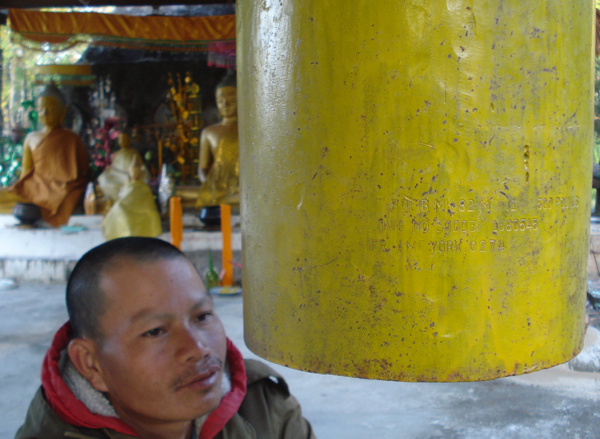
A local man examines the bombshell, now used as a prayer bell in rural Laos.

From 1964 to 1973, American bombers dropped over two million tons of bombs on rural areas of Laos, a fiery sideshow to the conflict in Vietnam. About 700 lbs of bombs were dropped for every man, woman and child in Laos.
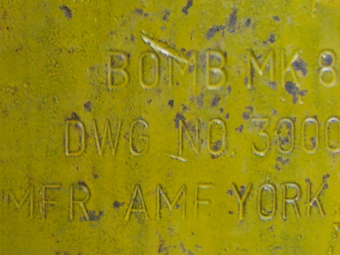
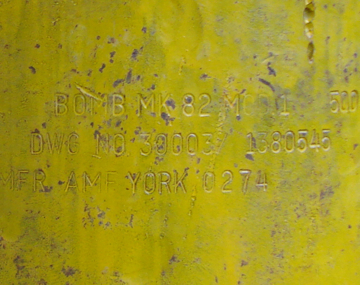
Here’s a detail of the writing on the bomb.

Some of these bombs failed to detonate on impact but are still active, and continue to kill and maim civilians today.

Often, people are killed while trying to harvest scrap metal from the fallen bombs.

Bombshells are now used as flower pots, as boats and as stilts for traditional Lao homes. The prayer bell bombshell in the photos is located at a temple in rural Khammoune Province.

You can visit the temple on a trek in the Phu Hin Boun protected area.

For more information on the legacy of the secret bombing of Laos, check out COPE, a remarkable organization based in Vientiane.

Other good resources include the films Bomb Harvest and the fantastic (unreleased) documentary The CIA in Southeast Asia: The Most Secret Place on Earth.

Learning about the massive bombing of Laos was an transformational experience for me, and the inspiration for my American Manifesto.


  • Stumble It
  • Share

About the Author

Matador ID: rsw

Tim Patterson is a travel instructor for Where There Be Dragons and a contributing editor to the Matador Network.

10 Comments... join the discussion!

  • Hal Amen replied on December 23, 2009

    I heard somewhere that more ordnance was dropped by the U.S. on Laos than was dropped by ALL countries in ALL of WWII. That’s f*&%ed up.

    (Report comment)

    ↵ Reply
    • Tim Patterson replied to Hal Amen on December 23, 2009

      What’s most f-ed up is that the bombing was deliberately kept secret from Congress and the American people.

      (Report comment)

      ↵ Reply
    • ross lee tabak replied to Hal Amen on December 23, 2009

      The numbers are a little slippery. It’s definitely more than the Americans dropped on Germany, probably on par if you include Britain. Throw in Russia and the Axis and WWII starts winning, and once you factor in the Pacific Theater the numbers aren’t even close.

      It’s sort of irrelevant, though. “Two million tons” and “more that we dropped on the Nazis” do a good job of illustrating the insanity of the Secret War, but all those numbers mean are how much all the bombs weighed (literally – this is different from saying a ‘five megaton bomb’, which refers to the explosive force and not the actual weight of the munition). It doesn’t give any idea of the destruction they caused – sort of like asking how many CCs your neighbor’s motorcycle is without knowing anything else about it.

      By the late 1960s, humans had figured out how to pack a lot more crazy into 700lbs of explosives. The US also used way, way more cluster bombs on Laos (which only exploded about two-thirds of the time) than they did on Germany, which is a big reason why you never hear about Helmut from Zwickau blowing his arm off while harvesting wheat. Then again, there weren’t nearly as many people in Laos and America certainly didn’t firebomb the hell out of any major population centers. The RAF’s eight day bombing of Hamburg in 1943 created a 1,500 foot flaming tornado and killed fifty thousand people, which is about how many civilians died in the entire Lao Civil War.

      So um, in conclusion, war sucks. Cut that shit out already.

      (Report comment)

      ↵ Reply
      • Tim Patterson replied to ross lee tabak on December 24, 2009

        Solid overview, Ross. Thanks for the comment and clarifications.

        Here’s a good map of the bombing patterns in Laos – most concentrated on the Plain of Jars and along the Ho Chi Minh Trail(s) in the south.

        http://copelaos.org/bombingmapofllaos.html

        (Report comment)

        ↵ Reply
      • Hal Amen replied to ross lee tabak on December 24, 2009

        Sweet, thanks Ross, for bringing the facts to my “I heard somewhere.” Appreciate it.

        Tim, that’s a great map.

        (Report comment)

        ↵ Reply
  • Marie replied on December 23, 2009

    Thank you for writing this, Tim. After living in SEAsia I really had my eyes open to these issues. It’s very humbling to think of the contrast of my childhood in the US in the 1970 to that of people living in this region at that time. I think most of us really have no idea as to the lasting effects of the things we’ve done in SEA. We might have suspicions, but the information has not really been there for us until recent years. We tend to think of the Vietnam War as finished a long time ago, and I don’t even remember it being discussed in my high school (in Georgia) very much in the late 80s. It’s as if it’s a part of history only. But for many in SEA the effects are still carrying on everyday. People walk over landmines at a ridiculous rate and many, many people are still getting cancer, and birth defects from exposure to the chemicals that we dumped on the region.
    As much as it leaves a bad taste in our mouths, we need to know about things like this so we can affect change for the future. Thanks again!

    (Report comment)

    ↵ Reply
  • Sarah Irving replied on March 5, 2010

    Bizarrely enough, if you look up those manufacturer codes, this bomb casing was cast by American Machine & Foundry, which is now best known as a bowling machinery manufacturer and leisure operator…

    (Report comment)

    ↵ Reply

Leave a Comment

Get Matador in your inbox and around the web.

Sign up for our FREE weekly newsletter.


View full list of RSS feeds

Jump To Category:


Travel Insurance.


Popular Stories on Matador

10 Constants of Air Travel

... 

Photo Essay: Wreck Diving in the Great Lakes

Diving in the Midwest isn’t as glamorous as diving in... 

5 Tips for Desert Camping

Deserts are full of interesting plants and animals, and... 

Urban Homesteading: Turn Your City Home Into Country Living

Who says you can't have a farm in the backyard of your ... 

What's Your Travel Personality?

Figuring out your basic personality type might just hel... 

Pakistani Politics: Why Women's Voices Matter

Violence in Pakistan dominates the headlines. But rarel... 

The Math of Falling Off a Cliff [Video]

Skip Garibaldi is a mathematics professor from Emory Un... 

Experience the Art of Improv Travel

Travel is more about how you do it, not where you go. F... 

13 Classic Japanese Junk Foods

Think of a long and perfectly cylindrical Cheeto, with ... 

How to Be Your Own Chai Wallah

Learn the skills of a chai wallah by creating your own ... 


Focus


Editor Blogs