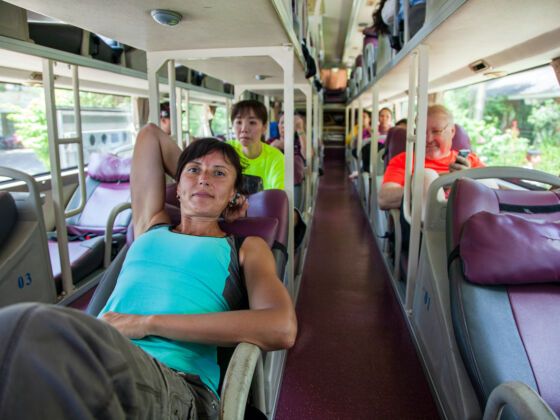
Feature Photo: Jen SFO BCN Photo: sethw
Living abroad is the act of cultivating a sense of superiority to “the tourists.”
Travelers (who often consider themselves the cultured half of the supposed traveler/tourist dichotomy) try to pull off this superiority to tourists as well, but at the end of the day they have to admit that they have no idea what the price of tomatoes per kilo is or how to pronounce zempoalxochitl.
It’s those who are quasi-local, who have plants, cook and have managed the general grid layout of the town, who really perfect their scorn for tourists.
Expat treatment of tourists ranges from gentle condescension, as if the tourists were dense, pitiful, overweight children, to outright contempt, as if the tourists were an invasion of parasites sucking all the authenticity out of local culture. But in very rare cases does the expat actually see a reflection of him/herself in a tourist.
Photo: Ed Yourdon
Ah, but the reality is, folks, that at some point in time even the most seasoned expat was standing on some street corner looking dumbly in each direction and being silently condemned by Those Who Got There Earlier. Yet expats seem particularly quick to throw together a hierarchy, and they defend it like dogs defending the pack order.
The eager study abroad student is at the bottom of the ladder. Then come the English teachers, then the newer retired people, then the older retired people, then the newer retired artists, then the older retired artists. You can jump a few rungs in the hierarchy by virtue of participation in revolutionary politics or marriage to a local.
So what’s the purpose of all this if, at the end of the day, the study abroad student, the artist with his eco-hacienda, and the group of straw-hatted retired folks who’ve been here for twenty years are all foreigners?
I think it has something to do with a sense of vulnerability inherent to the experience of living in another country, in another culture. For as much as you may dress in huipiles and explain the subtle differences between mezcales, you’re still an outsider. Even the huarache-wearing down-with-the-people revolutionary living in the barrios outside of town is, at the end of the day, foreign.
Photo: another sergio
And while, in my experience, Mexico’s got nothing on Asia as far as making foreigners feel foreign is concerned, there are still walls—economic, social, cultural. And occasionally, foreigners bristle at the presence of those walls.
Hence, the vulnerability—who knows when that occasion will come, just when you feel that you’re in the intimate little cave of culture, huddled round the campfire with everybody else, when suddenly BOOM a wall goes up and you realize that nope, you’re actually outside looking in.
I don’t want to give the impression here that expats can never truly belong to or be part of a local culture. No, not at all. But belonging is a precarious and fluctuating state of being, not a constant.
And perhaps feeling that, consciously or unconsciously, expats throw up an extra wall between themselves and tourists. So that at least if the wall gets thrown up between them and Mexicans, well, they’re still not outside the moat yet. There’s a big ol’ wall between them and the tourists in white tube socks and sandals.
And an even bigger wall, expats are quick to point out, between them and the big dude in the San Diego T-shirt drinking Negra Modelo out of a can in front of Santo Domingo at 3 p.m. and shouting “Honey! Take me a picture!”
Photo: Garry Knight
All those tourists are reminders, sometimes subtle, sometimes painful, of the essential expat vulnerability.
I’m waxing on about this because yesterday was one of those days when that vulnerability came on sudden and unexpected.
I went roaming around Oaxaca’ s various libraries, searching for inspiration in old atlases and yellowing history books. Didn’t find inspiration, but definitely confronted my outsiderness.
I can’t describe exactly where the feeling comes from, but suddenly it’s there—standing in the weighted silence of a library room with a bunch of school girls giggling and whispering behind their hands, the librarian staring out of the corner of her eye, people shuffling past and casting a sideways glance…and the vulnerability becomes palpable, like a shift in the air.
It’s hard to shake once it’s there, and it throws off one’s sense of balance. The urge is to mentally shout, but no, I live here! Really! I speak Spanish! I’m not….dum da dum dum…a tourist!
But really, isn’t this vulnerability and this outsiderness part of what makes us go abroad in the first place? To see everything, the most minute details, with freshness, with exhilaration?
I ran into a group of tourists later that day on the andador in the center of town, and stood behind them as they took photos of Santo Domingo. For the first time in awhile, I stepped back and craned my neck to admire the cathedral. It was huge and imposing, glowing with late afternoon light, set against one of those impeccably blue Oaxacan skies. How could it have been so long since I’d looked at it?
About the Author
Related Posts
22 Comments... join the discussion!
-
-
I really enjoyed your post, Sarah! I haven’t had the experience of living overseas for a long period of time, but as a shorter-term student/English teacher in Brno, Czech Republic, I’ve experienced the outsiderness you felt in the Oaxaca library.
I also felt like I didn’t fit in with the tourists. I wasn’t sure why at the time, but now that I’ve read your post, I think that perhaps I, like other expats, had built a wall to protect my vulnerability.
↵ -
It did bring a bell in me, Sarah.
It’s amazing but it’s indeed the case: the separation between expats, tourists, and between expats themselves.
I think that it probably comes from the fact that being considered as ‘theirs’ and being integrated comes with a price…
I was in this situation already twice (and now the third time), – it was easier for me in Brussels, as language was easier, and i was younger, but still it was big work to be integrated there. In Amsterdam it was more than work, – it was 6 years of hell but I managed to become more or less local.
And indeed, once you are there, – you do tend to look at others as tourists…
I suppose it’s a natural instinct. We look in the same way at all first-year students.
Great post, Sarah↵ -
I think it depends indeed on the country. Netherlands, despite claiming to be open and tolerant, isn’t that easy to get integrated into, even if i did get there eventually (and am quite proud of it).
I think Japan is also very difficult for expats, – you lived there shorly, didn’t you? What was your experience there, Sarah?↵ -
You seem to have had quite good experience in Japan!
You speak French, – have you read ‘Stupeur et Tremblements’ by Amelie Nothomb (a Belgian author, – appropriated by French, – as usual, since she now lives in France)? It’s a great read in general and you laugh from the first page. She speaks about her experience in Japan, and for her it was a total nightmare. She spoke fluent Japanese, – but her colleagues asked her not to speak Japanese, as apparently it was insulting when a foreigner could manage that language that fluently.
I know little about Chinese culture, I am ashamed to admit. But I can understand their reservations. Russians, in some remote villages, are like that: very suspicious of foreigners.↵ -
Yes! yes! and Yes again!
Thank you for putting this into words. I’ve tried and couldn’t quite. The fact that our apparent status see-saws somewhat is what’s unsettling. It makes it hard to know the right behaviours? Should I do quite so much as the locals do? Is it misappropriation?
Because I work here, I’ve been able to reduce to my status to what I consider the most practical: I’m here to work. I do what I have and what I can. Beyond that, eyes and ears open: it’s all a learning experience.
I’ve read Stupeur…and had to both admire and pity that girl! (Also wonder how long before it becomes a Hwood film – lol)..I’ve often wondered what would happen if I decided to work for an Indian company!
↵ -
Another Matador contributor, Nomadic Matt, wrote an excellent piece on his blog that echoes the thoughts of this article.
↵ -
“But in very rare cases does the expat actually see a reflection of him/herself in a tourist.”
Precisely. Freud would have a lot to say about the unconscious psychological defenses of the expat.
↵ -
Great post, Sarah. I think you could say these “walls” get thrown up not just by expats but by anyone feeling vulnerable. Consider the immigration issue in the U.S., where very physical walls are being built by “Those Who Got There Earlier.”
↵ -
I think what tends to happen when you live overseas for an extended period is that you become consumed by the every day, and it is easy to grow jaded. I lived in South Korea for two years and Thailand for four, and It is exactly what can happen to me back here in the states, those things that are initially so appealing and unusual become typical.
Your “cathedral” moment is a classic example of how you have to take a step back and look again at something with a fresh perspective to appreciate it. For a tourist/traveler everything is fresh and new and appealing. For an expat, you have to MAKE it fresh and keep it fresh (ironically this often entails traveling somewhere else). Tourists and expats often don’t move in the same circles out of necessity due to differing interests, but I do remember appreciating certain travelers I met doing interesting things outside of the typical elephant trek and waterfall tour.
Bring as much knowledge and spirit of adventure as you can on a trip and you can go a long way toward increasing the respect you are shown by locals and expats alike…
↵ -
Having been an expat and a tourist the lines between are too faded to tell where one leaves off and the other begins. When does an expat stop being a tourist? If a tourist buys land and a house but is seldom there then what? The price of tomatoes can be known by simply asking. Many expats don’t speak the local language, and what of the tourist imigrant returning to the culture of their youth, are they tourists?
Too many possiblities to worry about, best to just toast the tomatoes for jeao mac len.
↵ -
Great post, Sarah and interesting comments. I don’t consider myself an Expat; sounds so final. I’m a transplant. Down here, in Okinawa, the Japanese are considered tourists and they blow money, so we welcome them!
↵ -
Whether one lives in a foreign country as an expat (as I have done in Mexico, Japan, Switzerland, Guatemala and India) or merely visits on vacation as a “tourist,” it is important to remember that we are all guests.
A number of years back in Mexico, where I still spend a few months every winter, one of the expats there was growing marijuana in his yard. The locals are very tolerant of us and really didn’t care about this. One day, however, his neighbor’s pigs wandered into his garden and destroyed his crop. He became indignant and made all kind of threats, revealing a very ugly side to his neighbors who happen to be his landlord. A few days later the federales showed up and carted him off to prison where he languised for years. No amount of “mordidas” would get him out.
As a lifestyle traveler, I always see myself as a guest, no matter which country I am living in. This has served me very well, indeed.
↵ -
Such an interesting topic that applies to so many around the world, thanks for putting my exact thoughts out there!
↵ -
You hit the nail on the head in this article. I have felt all the same things you describe. I have lived in Mexico for six years, Belize for two and now living in Guatemala. The scene you described in the library goes through every expat’s head at least once a day. Great writing!
↵ -
Great article!
Perhaps no matter how many years you live in a foreign country, there will always be that day where those walls shoot up and you find yourself in a quiet library viewed as the tourist and outsider. Maybe there’s a way that can be used to the advantage. It could definitely remind us to take that step back and remember the beautiful cathedral or shrine passed every day on the way to work is something to look at and appreciate with new eyes. That’s one reason why I’ve always loved introducing the island I love so much to new visitors. I can experience the excitement through their eyes and look on the things I see every day in passing in a new light.Thanks for writing words I’m sure so many people, myself included, have had difficulty conveying in the past.
↵ -
I don’t know that I’ve ever read an article where I’ve agreed so strongly, both with what was written in the post, and with the comments afterwards!
I have nothing to add, other than to agree with Eva that this line made me laugh out loud: “You can jump a few rungs in the hierarchy by virtue of participation in revolutionary politics or marriage to a local.” Also agree about the importance of the ‘cathedral moment’ – and that it’s often through watching the ‘tourists’ that we are reminded of where we actually are.
Great stuff, thanks!
↵


