
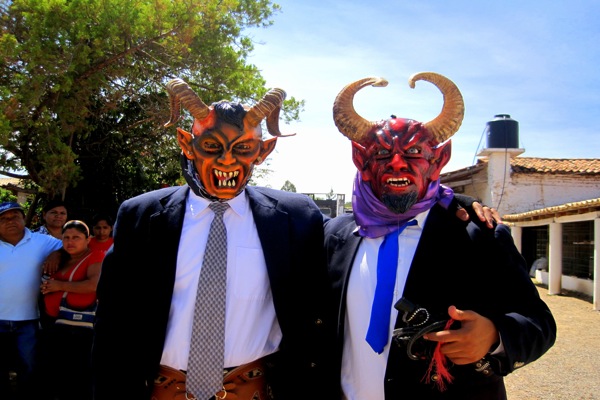
Photo: author
In a recent World Hum piece, Eric Weiner made the claim that Turkish baths and whirling dervishes, two traditional cultural practices he enjoyed in Turkey, would not exist today if it weren’t for the support of tourist dollars.
Young Turks, he asserts, have a waning interest in these practices and therefore tourism is all that sustains them. In his view, this “inauthentic” preservation of culture and these “inauthentic” cultural experiences are better than none at all. He states that the “travel snobbery” which criticizes tourists for courting such experiences and commercializing them is “rampant, insidious, and frankly, annoying.”
To this I respond:
If we’re attacking snobbery, is it not also snobbish for a tourist to claim that he and other tourists are responsible for the preservation of culture, since the locals can’t seem to bring themselves to do it?
I don’t think there’s anything wrong with going to a Turkish bath or a Mexican dance festival or a Balinese tribal ceremony that might feel slightly – or totally – constructed for tourist consumption. But I think celebrating this as the preservation of culture is self-congratulatory and smugly condescending, and it can wind up being imperialist.
If Mexicans or Turks or the Balinese no longer value the tradition being “preserved” and have lost interest in it, or see it merely as a spectacle for foreign tourists then really, whose culture are tourists preserving, and why? And more importantly, who has the right to decide whose and what kind of culture needs to be preserved? It sounds to me like the tourist is preserving his/her desire to experience the “exotic” and the “romantic,” and not a living, vibrant and necessary part of local culture.
When a cultural phenomenon has ceased to contain significance for local people and has become an entirely commodified experience produced for tourists dollars, it has moved into that 21st century society of the spectacle.
I don’t mean to imply that we should all throw up our hands in fatalistic acceptance that culture is dead, or that it’s going to die and there’s nothing we can do about it. But I also don’t think that culture is necessarily being preserved, or being preserved in a beneficial and productive way, simply because tourists pay for it. That argument inches us closer and closer to a world in which every cultural experience is something that is inherently designated for consumption, and culture is something determined more by what foreign tourists want to see and experience than by what local people actually believe in and practice.
It seems that what is bound to happen here is that Turkey could spiral off into the 22nd century, clogged with cell phones and traffic and Starbucks just like anywhere else in the world, while tourists go on paying for massages and traditional dances. And what, really, does that preserve? A certain sector of the economy? Tourists’ precious, foreign impressions of Turkish “culture”?
Weiner’s argument brings up Edward Saïd’s now familiar point about Orientalism – the West exoticizes and simplifies the East, fixing it permanently in the past and flattening its people and culture into stereotypes.
To a certain degree, cultural tourism that no longer has roots in a particular culture and that survives off of income from tourists does exactly this. Tourists go and look at a 15th century Turkey, reinforcing established notions of what Turkey should be and negating the country’s more complex and challenging modernity.
Meanwhile, the tourist dollars seem to instruct Turkey on what kind of culture it needs to have – here, you can’t protect it yourselves? We’ll do it for you. Saïd labels this process the internalizing of cultural stereotypes: tourists come in, establish what Turkish culture is via their ideas about the preservation of culture, and then hope that the Turks will internalize it.
I find the loss of traditional cultures distressing, but I don’t think that allowing traditional cultural practices to be commercialized and purchased by tourism is necessarily a positive solution, particularly when these cultural practices may hold far more meaning in the minds of tourists than they do in the daily lives of locals.
I think this solution also ignores so many of the factors that contribute to the death of traditional culture – devastating free trade agreements and the influx of multi-national corporations, the huge push of American capitalist culture overseas (particularly evident in modern Mexico), unchecked development, environmental destruction.
Tourists may keep paying for their cultural experiences in Mexican amphitheaters and Turkish hamams, in “cultural villages” in Kenya or Borneo, but that doesn’t stop the processes that devalue traditional culture and corrode it into a mere product to be consumed. The purchase of cultural preservation with tourist money also hints at a world in which someday, the Turks or the Mexicans or the Chinese might no longer have any connections to traditional culture, but tourists will still go into little bubbles and watch dances or ceremonies, pay their money, and leave, and culture will live on in tourist enclaves as an authentic, commercial simulation of what once was. Something similar like this could be happening in China, with the rise of the country’s ethnic minority theme parks.
This is the society of the spectacle at its most grim – traditional culture no longer holds intrinsic value for the people of a particular country, but inside the bubbles “preserved” by tourism tourists can buy a different, antiquated vision, a traditional culture that is no longer of importance and value to local people but has become yet another product they can sell.
I have two points here: the first is that conflating a tourist’s consumption of a traditional cultural experience with cultural preservation is dangerous. The commodification of any traditional practice for tourist consumption is something that should be considered and handled very carefully or else it threatens to divorce that practice entirely from the realm of local cultural tradition and turn it into tourist fanfare. Secondly, tourists should be very careful about claiming they have the right –and indeed, the responsibility — to preserve a culture that is not theirs. It smacks of condescension and imperialism and ignores the phenomena that contribute to the degradation and destruction of culture in the first place.
About the Author
Related Posts
15 Comments... join the discussion!
-
“That argument inches us closer and closer to a world in which every cultural experience is something that is inherently designated for consumption, and culture is something determined more by what foreign tourists want to see and experience than by what local people actually believe in and practice.”
Thank you for this article, and this statement. You so well articulated something that’s been in my mind but I haven’t been able to state nearly as eloquently.
Next month I’m going on a cruise. The reason is because my husband is currently working on one, it’s a six month contract, and this will be the only week in that six months I’ll be able to see him. Aside from that, am I looking forward to the cruise? Not particularly. It’s nothing I would be interested in doing if I didn’t have this reason.
And I’m not one of the “annoying travel snobs” referenced in the original article. I just know for a fact that the places we’ll dock at will not give me any sort of “authentic” glimpse into these people’s culture and lives. I don’t want to buy lots of little trinkets that will prove I spent three hours in that particular country one day. Will I lounge on the beach and enjoy it? Probably, yeah. But I don’t need a cruise to do that.
And what’s more, I don’t judge people that enjoy cruises. Luxury is nice. That’s great. Conversely, I don’t appreciate being called a snob simply because it’s not something I’m interested in.
Your points about the dangers of tourism “preserving” culture are so well-put, and a huge concern.
↵ -
Thanks for a thoughtful article that gives voice to a lot of my travel concerns when it comes to traditional cultures. I’m a frequent traveler to Hawaii, and have always avoided commercial luaus, although the issue there can be complex. Some luaus are a way for Hawaiian musicians and dancers to share aloha and their traditions, while at the same time earning money that keeps their arts afloat.
A few hula practitioners and traditional instrument players that I’ve interviewed on Oahu don’t see any split between their role in the community of preserving Native Hawaiian traditions while also earning money part-time by performing for a mostly tourist crowd in Waikiki. One kumu hula elsewhere on Oahu that I interviewed said that for her employed students, dancing in a show was what first motivated them to reconnect with their traditional roots, something they otherwise might never have done.
Of course, it takes time and some research to separate out purely commercial luaus from those that really do support traditional culture. I am afraid that not too many visitors are willing to put in that kind of thoughtful effort when picking their entertainment diversions on vacation in Hawaii, or wherever else they travel.
An important question is: How can we an independent travelers find out which traditional cultural performances are worth supporting, and which aren’t? I have some ideas, but am curious what other Matadorians would suggest.
↵ -
Absolutely loved this article, Sarah. I think that what happens oftentimes with travel is that people already arrive with collective images of places based on “otherness” and seek to confirm that in everything that they want to see and experience. It’s disappointing for a traveler to consider the truth that much, if not most, of the world has been deeply influenced by Western culture through trade, corporations, media, and, yes, even tourism in and of itself. Visitors to Mexico, for example, want pictures of “traditional” indigenous people and “traditional” dances. They aren’t interested in snapping away at a multitude of malls, people in western fashion chatting away on cell phones, or blonde hair blue eyed middle class kids that look like anyone back home, even if that’s just as much a part of the cultural landscape. I completely agree that culture is fluid and searching for the “authentic” is subjective and usually based on someone’s own ideas about a culture rather than the way that group sees themselves.
↵ -
A few years ago, I was working as a tour director for an educational tourism company, leading tours of students around Puerto Rico for five or seven days.
Many teachers lamented that Puerto Rico wasn’t “authentic” in the ways they hoped it would be. The comment always rubbed me the wrong way, but I used it as an opportunity to explain that what they were seeing was actually as “authentic” as it gets: the Dunkin Donuts, McDonald’s, and Subway on the corners of Viejo San Juan, housed in historic buildings constructed one or two centuries ago are the perfect metaphor for Puerto Rico’s history of colonization. The construction of authenticity is never made by the “other,” as Gabriela points out so thoughtfully in the preceding comment. Instead, it’s made by the tourist/traveler/whatever you prefer to call yourself. Thus, when we ask what’s worth saving or experiencing, we’re not asking the people who inhabit the culture–again, as Gabriela points out, Mexican emo kids with cell phones walking through malls is just as “Mexican” as Mexican kids participating in traditional indigenous dances.
↵ -
Another prevalent example of this is how American popular culture envisions Native Americans. It’s so much easier to conjure the image of the “noble savage,” living off the land (either that or casinos), than deal with the complexities of modern Native American life, socioeconomics, and “culture.” My NA Studies professor used to compare it to imagining that Brits still wear powdered wigs.
↵ -
Compelling arguments, Sarah, and so well-written
↵ -
Really great article. I enjoyed your use of Saïd’s ideas; I read Orientalism for a course in college.
In the Salzkammergut in Austria, the traditional culture is still very much alive, and something the locals greatly enjoy. For example, the pre-Christmas tradition of Krampus, when men dress up in hairy monter costumes with scary masks and huge bells on their backside and whip the other townsfolk. Or the pre-Lent Fasching celebration, where the whole town dresses up and a select group of men carry huge drums and go around town drinking free alcohol.
These are two examples that you wouldn’t see in Vienna, Salzburg or Graz.
↵ -
Two things pop into my mind on this one.
First, at the risk of sounding like an imperialist, I do believe that outsiders have the right to speak out in an effort to preserve or protect culture – to a certain extent, I think the art and music and clothing and customs and so on that human beings have created over the years belong to us all. An extreme – but still on point – example of this is the destruction of the Buddhas of Bamiyan. When the Taliban dynamited them, they took something from us all, regardless of the fact that Buddhas might mean little to local Afghans anymore. The same goes for the building of the dam in Egypt that threatened an ancient temple: outsiders objected, stepped in, and were heavily involved in a complex relocation process – not because westerners insist on seeing Egypt only in terms of its ancient civilization and have no interest in its modern reality, but because that ancient culture matters to anyone who’s interested in how we got to our collective modern reality. It doesn’t have to be sinister.
Second, I’m not convinced there’s anything wrong with this idea that “traditional culture no longer holds intrinsic value for the people of a particular country, but inside the bubbles “preserved” by tourism tourists can buy a different, antiquated vision, a traditional culture that is no longer of importance and value to local people.”
I’m going to take a Canadian example because I find it difficult to argue with Said – the obvious answer to any objection is that I’m too wrapped up in my own western cultural imperialism to see past my own nose. So. In Cape Breton, Nova Scotia, you can attend a ceilidh, listen to traditional fiddle music, hear songs sung in Scots Gaelic and watch young girls in kilts step-dancing. Does this represent the way Nova Scotians live now? Of course not. Do most Nova Scotians care about preserving these dying art forms, apart from the few who dedicate their lives to mastering them and passing them on? Probably not. But I don’t see tourists who go see these shows as bypassing the real, modern Nova Scotia in search of a fictional “authenticity.” I see them as enjoying a piece of our history, the same way you might in a museum. And I guess I see cultural performances and the like in other countries the same way – it doesn’t matter how relevant it is to today’s Turkey, or today’s Mexico, because I’m looking for a piece of the local past. That’s a big part of my travel process.
Now, I understand that a cultural performance in Mexico or Turkey comes loaded down with some baggage that one in Nova Scotia doesn’t – there are some totally valid points here about tourists and their expectations, particularly in, say, Asian or African countries. But I don’t think that baggage necessarily negates my point. I’m confident that I could go see the dervishes do their whirling thing without “fixing [Turkey] permanently in the past and flattening its people and culture into stereotypes.” I’m sure I’m not the only tourist who can manage that mental leap.
↵ -
eva,
you make good points, but they only seem to reinforce what sarah is saying.
i don’t interpret her rebuttal as an outright dismissal of potentially positive effects of tourism vis a vis ‘preservation,’ but, more ’something that should be considered and handled very carefully’ as exemplified by your points.
the main problem i had with the original piece was that it did read dismissively and seemed to be constructed out of fallacious arguments.
i looked at several of these here: http://thetravelersnotebook.com/notes-on-writing/how-to-discern-fallacious-arguments/
sarah wrote: ‘But I also don’t think that culture is necessarily being preserved, or being preserved in a beneficial and productive way, simply because tourists pay for it.’
i feel like that’s the ‘crux’ of this piece. it’s a nuanced but transparent declaration of belief, whereas weiner wrote ‘ The idea is simple: A culture is worth more alive than dead,’ which is a ‘bad analogy,’ a form of reifying.
↵ -
Hi Eva,
I see your point about ancient history belonging to us collectively as a human race, but I think that we’re wandering into dangerous territory when outsiders start claiming what has the right to be (and what must be) preserved. What pops to mind here in particular are battles for wilderness areas in Africa, in which foreigners (mostly Europeans and Americans) campaign for the preservation of these wide swaths of jungle, which I agree is an important thing, but without taking into account that there are people who actually live in or near these areas and who also want the opportunity for development and growth. Nowhere is this more evident than in the battle against poachers — yes, poachers kill animals that we consider to be part of our history as human beings, and yes, this is something that should be stopped, but they do this because they have been forced into poverty by a whole range of circumstances that anti-poaching campaigns do not take into account. Effectively, they are forced off their land and left with no livelihood. This is not to say, well, screw it, they should be able to build a mall in the middle of the jungle, but rather that so often foreigners’ arguments about their right to preserve other people’s land or culture end up marginalizing local people or forcing them into a static poverty and/or stereotype, and effectively neglecting the actual and sometimes dire circumstances of their lives.
Also, you talk about looking for a piece of the local past as if it were part of the “travel process.” That’s great if for you it forms part of a wider picture of a place. My point is that for a vast number of tourists, the local past isn’t a part of the process — it’s the whole narrative. I remember talking to backpackers in Borneo who took longboat cruises upriver for two weeks to find “the real Borneo.” Well, if you have to take a cruise two weeks into the jungle to the last outpost of one tribe still living in the traditional longhouse, then maybe that is no longer the only version of the real Borneo, right? But so often that’s the narrative travelers want, that’s what they look for, and that’s what they take home with them. They skip Kota Kinabalu, the capital city of Sabah, because it’s not real enough or authentic enough, ignoring the fact that while they’re in Sarawak’s cultural village or a simulated long house the “authentic” Borneo of 2010 is completely passing them by. It’s an either/or situation, not a process, for so many tourists. I see the same thing in Mexico — how many articles have you read about the “real” Mexico? What is that? Because I see the real Mexico not only in indigenous dances, but in the Cinnabon that just bought prime space on Oaxaca’s main pedestrian street.
I’m not saying that this means that local cultural traditions will die, and oh well. But rather that the “local past” and its traditions are often placed in this stagnant, unchanging bubble for tourists, while the rest of the culture is trampled by development (which tourists would rather ignore). At its most extreme (and I’m not saying this is inevitable or it happens wherever tourism thrives) this leaves us with a situation in which all that’s left of culture are false, recreated experiences that tourists pay for.
There’s obviously a lot of room, however, for positive tourist experiences that do help preserve parts o the local culture that are important to local people. Take, for example, the tourism surrounding the coca leaf in Bolivia. That’s a crucial part of Bolivian culture, and Bolivians have developed a tourist industry around it. I think that’s fantastic. But that was a Bolivian decision, and its an industry managed largely by Bolivians, not foreigners.
↵ -
Such great points about seeing the “real” (insert country here). I find myself sometimes falling into that trap…you’re completely right. Most travelers don’t want to see the “Cinnabon” because that’s exactly what they’re trying to escape. They want something exotic/different, hence cling to a romanticized version of a place, and hence seek out these “real” experiences.
As the world continues to shrink through globalization and cheap airfares, it will be very interesting, and probably sad, to see what will become of reality.
↵ -
I think this is a really important discussion to have, and I’m stoked to see people going about it respectfully. “Cultural preservation” tourism is a complex issue at the heart of the traveling experience, and it’s great to see such a nuanced discussion opening up around it.
↵ -
It’s tempting to blame past fiction writers for this idealistic, mythical point of view. I partly blame guidebooks. A traveler has to be careful to distinguish what’s historically or culturally significant versus what’s “authentic”.
Chatting with a guy who works at 7-11 in Bangkok is authentic. He works there, you struck up a random, but welcome dialogue with him – it wasn’t contrived or part of a package tour.
Visiting a Khmer temple with hundreds of other tourists and snapping photos is educating yourself on a cultural/historical piece of Cambodia, which can explain subtle, but present behaviours or norms. It’s only a component, not reflective of a country as a whole.
The fall of economic borders is a reality, spilling across all forms of expression (food consumption, music, art, etc.). It’s unavoidable. Perhaps travelers need to redefine what is romantic?
And Sarah was spot on about the imperialist slant. Female genital mutilation (FGM) in some African nations comes to mind. Feminists groups rallied passionately to stop this barbaric practice. I’m not implying it’s a solid practice by any means, but Westerners overlook the cultural significance the practice holds. It can be a rite of passage for village women and prepares them for marriage – tying into standards of beauty. Again, not saying it should be preserved, as some young women suffer from complications, what irks me is the arrogance leveled at the issue. Us enforcing our beliefs on others who don’t live like we do, or value the same things that we do.
And to clarify, I call myself a feminist, so there.
↵


