Pies, Puddings, And Pints: A Foodie Guide To London

02/2/10  Print This Post Print This Post    21 Comments   Popular   Written by Sarah Menkedick
  • Stumble It
  • Share

Photo: author

British food is coming into its own.

Hold on to your seats, ladies and gentlemen: it’s not just mushy peas anymore.

Well, actually, it IS mushy peas, but this time with a celeriac foam reduction and a duck egg Parmesan crostini in a martini glass on the side.
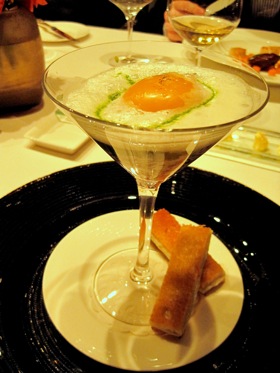
Photo: author

British food hasn’t necessarily changed; it’s just realized that hey, it can stand out on the international foodie scene, too. As Iqbal Wahhab, owner of Borough Market’s glass-walled, light-filled restaurant Roast put it, the British have just recently begun to value their own food traditions.
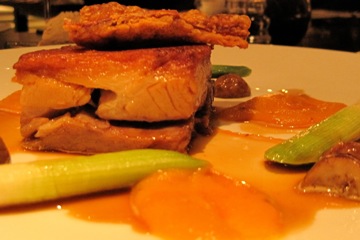
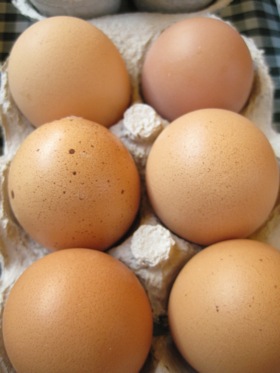
Photo: author

This is evident in the current foodie trends, which emphasize local legumes and veggies (lots of turnips, potatoes, celeriac, lentils, mushrooms and the inevitable peas), staple British meats (roasted Cornish hens, quail, lamb, pork belly) and of course, fish (avec or sans chips).

There are an abundance of Indian, Pakistani and Bangladeshi restaurants, but I’m going to set those aside for another piece since I didn’t have time to explore them, and I’d like to delve into the emerging phenomenon of traditional British cuisine.

Chefs are dressing up British fare with the type of stellar presentation and attention to detail that one might normally associate with say, Italy or Spain. The local ingredients they have to work with render wild fusion feats unnecessary, and the elaborate blending of exotic foreign cuisines that characterizes so much of American food culture isn’t as obvious in Britain.

As the aforementioned Wahab pointed out, the real work of a restaurantor at the moment is sourcing exceptional ingredients and allowing them to shine. Wild beef and lamb, Stiltons and Blues and Cheddars to make you weep, fresh local fish and oysters, creams and butters from organic British dairies.

So where to begin your foray into British food?

Borough Market

Photo: author

Any good foodie will lose herself for at least an afternoon in London’s Borough Market, wiping tears from her eyes at the gorgeousness of stacked blocks of cheese and plump, speckled free range eggs.

The setting itself is a spectacle; the area has been a marketplace since the 11th century and has that charged historical energy of a place where humans have gathered for thousands of years. With Southwark Cathedral towering stoically behind you and the labyrinth of vendors in tiny winding streets, it can feel as if you’ve drifted back to an 18th or 19th century London market day.

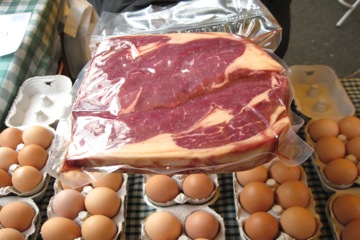
We talked with vendors about the rise of a foodie scene in Britain and they traced it back to the mid-1990’s, when people began expressing an interest in organic, local and seasonal food. Lizzie Vines, one of the owners of Wild Beef, a Devon-based farm which prides itself on being “more than organic” and grazing its cattle on natural, health-rich local foliage, said she’s seen her and her husband Richard’s company take off in the past ten years.

Photo: author

Wild Beef is at the forefront of a foodie movement in Britain, encouraging producers to work with the climate, the fertile soil and the local landscape and to ride the flow of seasonal changes. The result is not only a beautiful steak filled with minerals from diverse plants and grasses, but a sustainable and healthy environment.

Photo: author

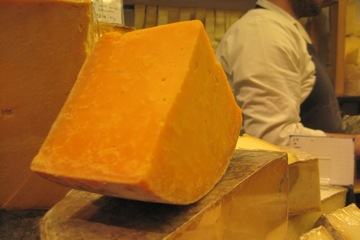
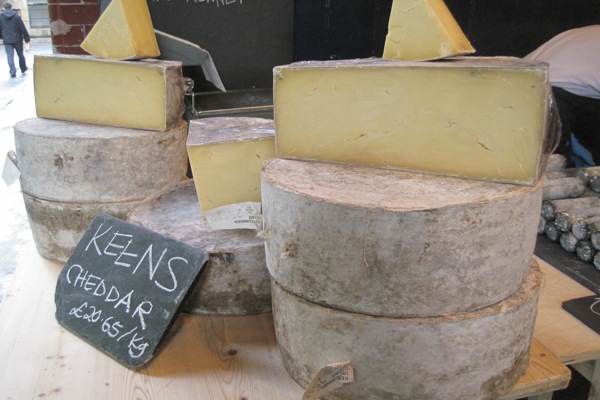
The cheese-obsessed can also irritate the staff at Neal’s Yard Dairy for hours, grilling them about the fermentation of Brie and asking for sample after sample. I hovered around the huge, photogenic blocks of cheese absorbing them through osmosis, fantasizing about customs officials not finding them in my checked luggage. There were fat rolly-polly blocks going black and blue with age and prestige, cartoonish wedges of cheddar, soft, sighing slices of Camembert. The shop offers cheese tastings and classes.

Then there’s Northfield Farms, which specializes in beef, pork, and lamb, and sources meat to celebrity chefs like the idolized Jamie Oliver. I liked the place because the butcher, Brendan Maguire, had a killer cockney accent and was the one and only Brit in my whole stay to call me “dahlin.” He pointed out that in Britain, a farm can use pesticides 10% of the year and still be organic, and was highly critical of the organic certification process.

From what I observed, Britain doesn’t have the same fascination with the organic title as the U.S does. Local food and knowledge of where food comes from and how it’s produced seem to trump the term organic. Maguire was adamant that food labeled “wild” could never be “organic” as organic refers to food that has to be very carefully monitored and cultivated. I nodded enthusiastically partially out of agreement and partially out of fear of how the cockney accent might take me down if I ventured to disagree.

There’s also locally raised and farmed ostrich meat at Gamston Wood Farm (herbed ostrich meatball, anyone?), award-winning Welsh cheese, hot mulled wine and cider, and a beer shop, Utobeer, which has over 600 beers from around the world and is part of a push to revive British microbreweries which suffered after the major breweries took over many pubs in the 1980’s.

Photo: author

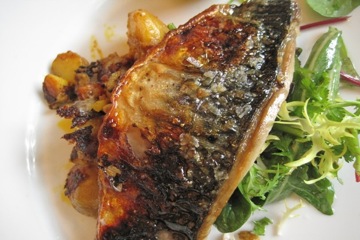
Phew. Alright. On top of all the stalls, there are also restaurants and coffee shops fitted into the industrial framework of the market. We had lunch at Wright Bros Oyster Bar, where I ate each bite of mackerel and spiced potatoes as if it were my last. If you don’t feel like sitting down or doing the restaurant thing, there are steaming pots of curries and paellas which are spooned into boxes to be eaten on the fly.

The Gastropub

Photo: author

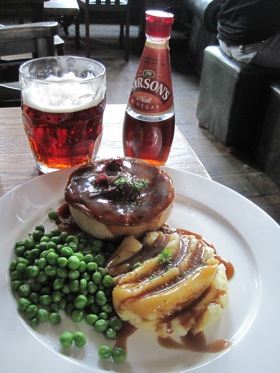
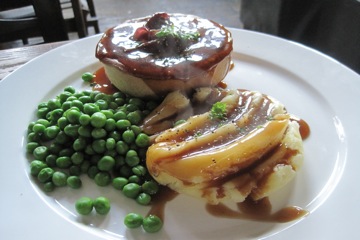
The gastropub has become a British institution. I experienced it in Camden, a London neighborhood known for its markets and its goth/punk past. The Hawley Arms is all high ceilings, old wood, and stockinged hipsters sipping pints in front of fireplaces. I had a pint of ale, a “minty lamb” pie (mint, herbs, and organic lamb) and peas and mash. At first I thought the peas were a sort of ironic hipster joke but no, they’re apparently as inseparable from pies and mash as Mac n’ Cheese is from American childhood.

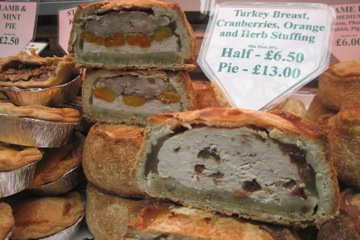
The pub, I must say, cannot be done without a pie. Pork, lamb, beef, or maybe goat cheese and sweet potato for vegetarians. The crust is distinct – strong, dense and flaky at the same time. The best pies will have a crust that can hold its own, and a steaming interior of herbs, meat and veggies. The mash should have a dark, vinegary gravy and a thick texture – nothing like the mashed ‘taters that come out of boxes in the U.S. Top the whole affair – peas, mash, pie – with a dash of vinegar.

Photo: author

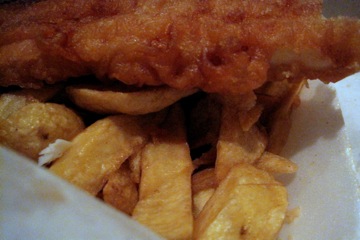
You could also go the fish and chips route, although I’d recommend saving that for the latter half of a long, raucous, beer-infused evening, when sitting in the corner of a fluorescent shop with vinegar dripping down your fingers and a plate of piping hot fried food in front of you is nothing less than divine.

Gastropub fare also includes bangers and mash and bubble and squeak, which sound like zany characters in a new age cartoon but are in fact basic tenets of British cuisine. Bangers and mash are sausages and mashed potatoes, and bubble and squeak (way up there in the list of all time greatest national dish names ever) is a mix of veggies left over from a Sunday roast. The roast, exactly what it sounds like, is also a gastropub essential, usually served on Saturday or Sunday (think British, carnivorous brunch).

Photo: author

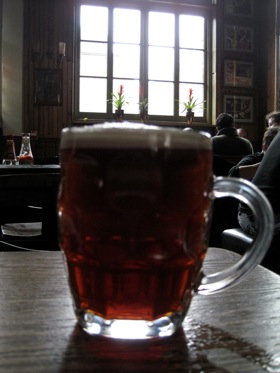
Whatever route you go, you must pair it with a pint. Then, you can take 5,000 pictures of that pint like I did, since British beer is somehow so photogenic all brown and caramel in its glass. Sadly, microbrews are hard to come across, as most pubs are run by one or another major brewery. Stella Artois, a Belgian brew, is a good standby as other ales tend to be a bit watery and are much less carbonated than American beers.

Pies and Puddings : The Essentials

Photo: author

We seemed to keep running into the same ingredients and concoctions everywhere, perhaps because the emphasis in foodie world is so much on the seasonal. Polenta was the vegetarian standby; a whiter, creamier version with Parmesan, eggplant (aubergine) and zucchini (courgette: yes, Britain is closer to France than we are).

There were halibut and mackerel cooked in butter and served with spinach and/or potatoes, and roast lamb and pork belly, falling off the bone and ever so slightly pink. Beets – beetroot, in British terms – were a popular garnish and added a great, deep sweetness to savory mushrooms and the bite of vinegar.

Warning: just about anything can be a pudding in Britain. If you see pudding on the menu, do not cringe in disgust at the thought of one of those sad little plastic puddles of artificial chocolate or vanilla. No. Pudding can be a fluffy, buttery roll, a sort of hollow and lightweight biscuit, a savory stuffing-esque concoction of meat and raisins, or a desert (sometimes menus will have a whole section labeled “puddings,” which apparently include chocolate cakes and apple strudels). When it doubt as to nomenclature, the British seem to think, call it a pudding.

Cocktail wise, it’s all about the elderberry and the bramble (a Scottish fruit that looks a bit like cassis) mixed with vodka or whisky.

Photo: author

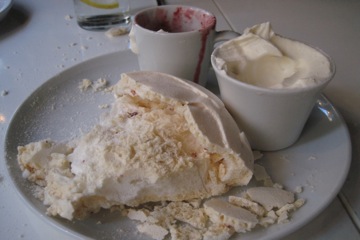
And finally, desert. Oh, desert. I am pulling myself back from the brink of drooling pseudo-poetic rhapsody here to tell you, straight up, that desert rocks. Meringues (sometimes called “pavlovas”) look like puffy white buns, but don’t be fooled. They are brittle and explosive. It is near impossible to crack into one without causing a SMACK! and a burst of debris around the tabletop.

Apparently, according to the waitress who I’m sure disappeared a moment later to mock the clueless American tourists, it is normal to create a mini disaster area of meringue bits and pieces. You then scoop these up, coat them with cream and berries, and get to feel as if you’re not really mowing down a heavy desert because the meringue is so light it melts in your mouth.

Photo: author

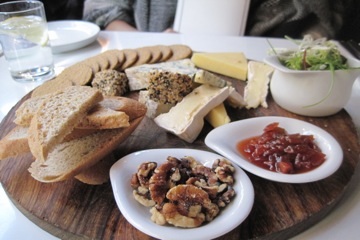
The cheese, oat cakes, and chutney combo is also beautiful. Usually you’ll get four or five cheeses, oat cakes, and an assortment of sweet chutneys. I tried the fig, date and walnut chutney spread on a grainy oat cake (a small cracker) with a chunk of soft, pungent Camembert. Yes. I could not speak for a few moments. Then I came around and dug into the cheddar.

To sum up, ladies and gentlemen, don’t blow off British food. It’s coming into it’s own. The British seem to be realizing that they have some phenomenal local ingredients which, when fleshed out and dressed up just a bit, can wow the foodies that normally head on over to France and Italy to eat.

The most distinctive feature of the foodie scene in Britain might be the fact that, despite the enormous popularity of Indian food and curry, the up and coming focus is really on classic, ancient British foods. And since I’m a huge believer not only in the locavore and slow food movements, but also in the assertion that one of the best ways to get to know a culture is through eating, I highly recommend a foray into British food. A pint, a pie, a pudding – and you’ve come to know a bit of Britain.


  • Stumble It
  • Share

About the Author

Matador ID: SarahMenkedick

Matador Contributing Editor Sarah Menkedick is a freelance writer based in Oaxaca, Mexico. Her writing has appeared in print and online publications, including Literary Traveler, Abroad View magazine, and National Geographic Glimpse. She has traveled, lived, and taught on five continents, and is constantly in pursuit of spicy food, dark beer, and new places to run. Check out her website of photography and creative nonfiction inspired by travel.

21 Comments... join the discussion!

  • Eva replied on February 2, 2010

    Great guide, Sarah, but you lost me at Stella Artois! I think you’ve gotta go with a big-name British ale, if that’s all you can get, over a foreign lager. But then, I like my beer warm-ish and mildly carbonated.

    (Report comment)

    ↵ Reply
  • Sarah Menkedick replied on February 2, 2010

    I agree, but I really couldn’t find the big name British ales! They had basics like Heineken and Budweiser. Nicer restaurants had microbrews, but pubs mostly had these standard lagers. Plus, I need a good, strong, cold beer…can’t do the mild stuff. ;)

    (Report comment)

    ↵ Reply
  • Natasha replied on February 2, 2010

    I want that pie.

    (Report comment)

    ↵ Reply
  • Julie replied on February 2, 2010

    I’m all about the herbed ostrich meatball. And I love your description of cheeses. Great to see your photos!

    (Report comment)

    ↵ Reply
  • Paul Sullivan replied on February 2, 2010

    I miss pies :(

    (Report comment)

    ↵ Reply
  • Tim Patterson replied on February 2, 2010

    I am SO HUNGRY right now!

    (Report comment)

    ↵ Reply
  • Candice replied on February 2, 2010

    My god I miss British food. Especially onions in EVERYTHING.

    (Report comment)

    ↵ Reply
  • Joya replied on February 2, 2010

    This is great and so detailed. Borough Market is probably my favorite market in London. I could spend a whole day there! I can’t wait to go back to London!

    (Report comment)

    ↵ Reply
  • Valerie replied on February 3, 2010

    Sadly I wasn’t yet a foodie when I lived in London. This piece so makes me want to go back!

    (Report comment)

    ↵ Reply
  • joshua johnson replied on February 3, 2010

    Killer piece…bangers and mash perfect with beer and perfect for a hangover!

    (Report comment)

    ↵ Reply
  • neha replied on February 4, 2010

    Borough Market! I remember stopping at one of the brownie stands there. At time, that’s all I remember.

    (Report comment)

    ↵ Reply
  • Amanda replied on February 4, 2010

    I am a fan of Samuel Smith’s beer. You can find it in pubs, but not every pub. Windsor Castle pub in W1H is a great place for ales. The Handlebar Moustache Club meets there every month!

    (Report comment)

    ↵ Reply
  • ZoeSmith replied on February 5, 2010

    This piece definately makes me miss home… there is nothing like a Sunday roast, a good old bangers and mash or a healthy portion of chips and gravy at 3 in the morning!!

    (Report comment)

    ↵ Reply
  • Lisa at Wanderlust Women replied on February 8, 2010

    I have to tell you that the food market in Royal Greenwich has some amazing, tasty finds. It’s well worth the train or boat ride to get there. You can graze all day!

    (Report comment)

    ↵ Reply
  • Kallen replied on February 8, 2010

    The USDA (United States Department of Agriculture) has not been strict in monitoring companies ethical practices and enforcing their standards. There has been countless times of food manufacturers were exposed by watchdog groups for not being honest in their ethics. And when the USDA is asked why it is labeled organic, it is almost “no comment” or they are not around for comment. Every time I’m at Whole Foods and I see the USDA Organic logo, I question it. I usually look for the QAI (Quality Assurance International) certification.

    I would eat London’s food over USA organic food any day.

    People in countries as in London, France, Italy, and many others actually take a pride in producing a quality product. America is all about quantity over quality which is the reason why America is one of the top sickest first world nations.

    (Report comment)

    ↵ Reply
  • Justruss replied on March 11, 2010

    Oh come on!

    This is a lovely article and I am happy to read that the Britts are finally preparing creative and palatable fare, but the article doesn’t have to be written (or read) at the expense of American food. I just visited the US after living in Europe for six months – Czech Republic to be specific. My wife and I visited some fabulous restaurants and prepared some lovely meals using some of the finest and freshest ingredients on earth. American has artesian foods in abundance and remains a haven for creative chefs from around the world.

    The duck eggs look lovely Sarah, and that steak is to die for. We need more articles like this one.

    (Report comment)

    ↵ Reply
  • Redha replied on April 10, 2010

    ooooh please tell me where I can find that seemingly to-die-for meringue and cheese(camembert) platter?!? :)

    (Report comment)

    ↵ Reply
  • Laura replied on April 15, 2010

    What about the Scotch Eggs?… just so happend i can recommend the ones at the Harwood arms on Farm Lane in Fulham…

    Also on the subject of fish and chips…. Fishers Fish and Chips on Fulham Palace road … but them and then walk up to Bishops Park and enjoy them in the sunshine with a view of the river…

    (Report comment)

    ↵ Reply

Leave a Comment

Get Matador in your inbox and around the web.

Sign up for our FREE weekly newsletter.


View full list of RSS feeds

Jump To Category:


Travel Insurance.


Popular Stories on Matador

10 Reasons You Know It's Time To Go Traveling

Feel like you need escape? Find out how badly with the... 

Vote Zach To Take Over For Lady Oprah

A man, a wheelchair, a wig, and a dream. ... 

How To Bake Your Own Amazingly Easy, Incredible Bread

Join the artisan bread revolution today!... 

#MusicMonday: The Internet's most inspirational music videos

Matador presents our favorite inspiring music videos.... 

Urban Homesteading: Turn Your City Home Into Country Living

Who says you can't have a farm in the backyard of your ... 

Swinging Mallets and Breaking Beers: An Intro to Extreme Croquet

The only sport where your victory may be determined by ... 

How to Back Up Google Docs

Taking for granted that Google will always be there mig... 

Notes on Backcountry Visa Renewal

Km 14. 7 - "Began limping due to increasing pain in lef... 

What NOT to Do in Istanbul

Matador's destination expert on Istanbul lays out the c... 

Natural Remedies From Around the World

Try these natural homemade remedies from around the glo... 


Focus


Editor Blogs