Indigenous Languages of South America: Where to Learn Them and Why You Should

07/27/10  Print This Post Print This Post    12 Comments   Popular   Written by Camden Luxford
    Share

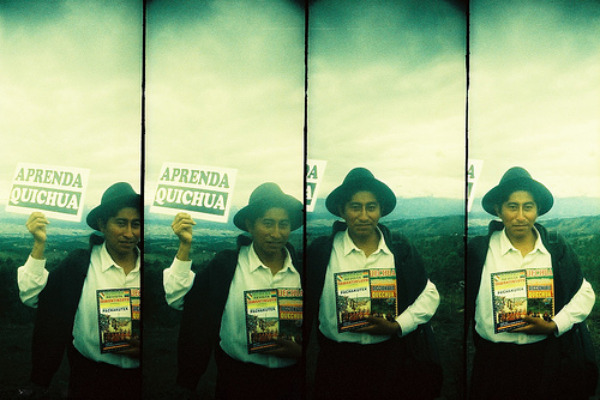
Photo: unojofuerte

They’ll never make the Critical Languages List, but indigenous South American languages still merit a place on many people’s “To Learn” lists.

If you’re planning on working or volunteering in the fields of human rights, development, education or politics in the region, Spanish will get you by, but nothing will open doors like acquaintance with the local indigenous dialect. Many of these languages involve a way of thinking and looking at the world vastly different from that of Spanish, and an inadequate understanding of these differences necessarily inhibits communication.

The Aymaras in Bolivia, for example, approach logic in a completely different fashion , assigning values of “true”, “false” or “uncertain” to each statement. Unlike in Spanish or English, they are able to logically derive conclusions from uncertain premises in a mental leap completely beyond the capabilities of those accustomed to thinking like a European.

Beyond the practical benefits of increased understanding or deeper cultural travel, these languages pose a fascinating study of the human capacity for language and provide a unique mental exercise for those already comfortable with European languages.

While hundreds of the languages in the region are in danger of dying out, or are spoken by so few people that your reasons for learning would have to be pretty specific, many governments are beginning to make at least token efforts towards the preservation of some of the major languages in the region. Here’s where you can learn the big three and why you might want to.

Quechua

Famous as the language of the Incan empire, although it actually predated them, Quechua is still spoken by around 8.5 million speakers across Brazil, Bolivia, Argentina, Ecuador, Colombia, and, of course, Peru, where it is the second official language. While in reality a language family, with several dialects and languages, some mutually intelligible, some not, a good place to start is with the Quechua of Cusco or Bolivia. Highly similar to each other, together they have the greatest number of speakers, and the small amount of surviving literature and theater of the Incas is in this dialect.

Quechua is quite easy to learn. It’s entirely regular, with no adjective agreements or indefinite/definite articles, although you’ll have to wrap your head around a totally unfamiliar vocabulary and a few extra sounds. The most challenging, and fascinating, aspect of the language is its system of evidentials. Each sentence must be qualified by what your source is for that piece of information, and how much you’re willing to commit to it being true – whether you saw it with your own eyes, heard it from a reliable source, are inferring or speculating. If only they’d introduce something like that on the Internet.

Where to Learn Quechua

Cusco or Bolivia are the best places to learn. Keep in mind the Bolivian regions around La Paz and Lake Titicaca are Aymara-speaking, so if you’re keen on Quechua you should base yourself in or around Sucre, Cochabamba or Potosí. Many Spanish schools also offer Quechua, or you can track down private lessons – expect to pay between US $3-4 per hour (possibly less in Bolivia).

Aymara

When the linguist Ludovico Bertonio was studying Aymara in the early 17th century, he became convinced the language was too perfect to have developed naturally – that it’s remarkably regular pronunciation, extraordinary fertility and articulateness, and its ability to handle abstract concepts could only be the work of gifted creators.

Many also argue that some form of Aymara was the so-called “secret language” of the Incas, used for private communications between the elite, while the empire at large spoke Quechua.

Whether you subscribe to that theory or not, Aymara is a fascinating language, not only for the mind-bending logical structure mentioned in the introduction, but also for the sheer fact it managed to survive to still be spoken by over 2 million people today in Bolivia and the adjacent regions of Peru, Argentina and Chile. When the Spanish arrived, they tolerated the use of Quechua as a kind of lingua franca between their Indian workers while suppressing the use of other indigenous languages, and most of this century was characterised by hispanization programs which sought to “unify the nation” of many South American countries under the common tongue of Spanish. Despite all this, and despite its total lack of a dictionary or literature, Aymara lives, and the Bolivian government now caters to speakers with radio programs and official language status.

Where to Learn Aymara

Again, the Spanish schools are a good place to begin – stick to the Lake Titicaca region in southern Peru and Bolivia, or head to La Paz.

Guaraní

Paraguayan Guaraní is unique as the only indigenous language in South America which is also spoken by non-indigenous people as their mother tongue. The first of the South American indigenous languages to be awarded official status in 1992, Guaraní is now spoken by 95% of Paraguayans, most bilingual with Spanish, although the indigenous tongue tends to occupy a more rural, informal, intimate space. Textbooks tend to be printed in both languages, bilingual education is gaining strength, newspapers have Guaraní editions, and many politicians are Guaraní speaking. Even Paraguayan Spanish contains a large number of Guaraní loan words.

For those planning an extended stay in the area, Guaraní is an indispensable window into a more personal sphere of Paraguayan life.

Where to Learn Guaraní

Nearly 5 million people across Paraguay, Bolivia, Argentina and Brazil speak some form of Guaraní, however, varieties may be mutually unintelligible so it’s vital to consider where you plan to use it most. For Paraguayan Gauraní, many of Asunción’s Spanish schools also offer courses in Guaraní.

Community Connection

Looking to meet other travelers, language learners and expats based in South America? Check out Matador Travel’s South America page.


    Share

About the Author

Camden Luxford

Camden lives for long, uncomfortable journeys and dreams of the Trans-Siberian Railway. From hitch-hiking in Europe, through Asia by bus and boat, she has found herself in the Peruvian Andes, where she relishes the colors of the festivals, the warmth of the people and the hearty flavors of the soups. When she's not exploring her new home, she's studying politics by distance and writing for her blog, The Brink of Something Else, or as a regular contributor to Matador Abroad.

12 Comments... join the discussion!

  • Kirsten replied on July 27, 2010

    Great article! I’ve been thinking about learn Quechua for a while now; once I finish my nursing degree I was hoping to volunteer once a year in the Amazon, or at least somewhere in the Colombia-Ecuador-Peru-Bolivia area, and I know that speaking the native tongue is such a help. I speak passable Spanish but I would love to get to that point in Quechua too! Not being able to learn it at home makes it difficult though, it’s a little frustrating that I have to wait until I can get there before I can start learning :/
    It is a very interesting language, as are the others you listed! This was a very informative article.

    (Report comment)

    ↵ Reply
  • asalvesen replied on July 27, 2010

    This topic is something I always wondered about but never was disciplined enough to research. Thanks, Camden!
    I love how both Aymara and Quechua require the speaker to think about the veracity and certainty of what they are saying.

    (Report comment)

    ↵ Reply
  • Abbie replied on July 27, 2010

    So interesting! Thanks for this article :)

    (Report comment)

    ↵ Reply
  • Camden Luxford replied on July 28, 2010

    Hi Kirsten and Abbie

    Thanks for reading! Glad you found it interesting (I was worried it might be a bit too much of a niche topic!)

    Kirsten, I just took my first official Quechua class yesterday and oh wow what a shock to be back at the beginning of the language learning process again. The pronunciation’s a little difficult but my teacher assures me I’ll have my head around the grammar in no time, and that it’s much easier than Spanish. So I’m sure you’ll be fine when you finally get down here. Also, I did run across a few references to universities in N America and Europe that offer classes, maybe you could find something near you to get a headstart on learning?

    (Report comment)

    ↵ Reply
  • Allison replied on July 29, 2010

    What a great article, and a great way for people to expand their thinking of South America and who/what is down here. thanks!

    (Report comment)

    ↵ Reply
  • Camden Luxford replied on July 29, 2010

    @asalvesen – I loved that too! What a great way of approaching language and communication.

    @Allison – my pleasure! Cheers for reading.

    (Report comment)

    ↵ Reply
  • neha replied on July 29, 2010

    Camden, this is such an interesting piece. I had only heard of Quechua before.

    On a side not I love how the word ‘Aymara’ sounds. So very pretty!

    (Report comment)

    ↵ Reply
  • Pastore Riel replied on July 29, 2010

    Thanks for this thought provoking article. I love languages, and appreciate what you said about its connection to understanding a culture. There are so many things you can tell about thought patterns and point of view based on the building blocks of a language. I just spent hours reading more on Quechua and Aymara and found it fascinating how the concept of self and time can be contrasted with the western view of future forward past behind. To think of pointing forward for the past and motioning behind you for the future was interesting, until you understand how the past has been seen, but the future is still coming. Thanks again for this thought provoking post!

    (Report comment)

    ↵ Reply
  • Camden Luxford replied on July 31, 2010

    @Neha – no problem! And wow, I could’ve written on and on… so many fascinating languages down here but the dreaded word limit (curse you Heather! :) ) meant I had to restrict myself to the big three. It is a beautiful word, isn´t it? I love the sound of all three of them.

    @Pastore – my pleasure, I’m glad you enjoyed the post! I’m getting more and more fascinated by language the more I learn. I can’t believe how excited I am to get into Quechua, and especially to head out into the communities and use it. As you say, it’s such an amazingly different worldview, it’ll be a great challenge wrapping my head around it.

    (Report comment)

    ↵ Reply
    • Heather Carreiro replied to Camden Luxford on August 2, 2010

      Haha. That means you’ll just need to write another article covering some more languages!

      (Report comment)

      ↵ Reply
  • ayngelina replied on August 2, 2010

    What a great post, I’ve been struggling to learn Spanish as I travel through Latin America but it never occurred to me to also pick up some of the indigenous languages.

    But I think I may try to at least pick up some phrases to be respectful as I don’t want to assume they’ll interact in Spanish.

    (Report comment)

    ↵ Reply
  • Camden Luxford replied on August 19, 2010

    Any excuse will do, Heather!

    @Ayngelina – I think that’s a great idea. The people unfortunate enough to be on the receiving end of my appalling Quechua are all thrilled I’m learning. Following your travels with interest, by the way, keep having a great time!

    (Report comment)

    ↵ Reply

Leave a Comment

Get Matador in your inbox and around the web.

Sign up for our FREE weekly newsletter.


View full list of RSS feeds

Jump To Category:


Explore the Community


Popular Stories on Matador

Climbing the Brooklyn Bridge (Sort Of)

A climbing gym with good hours, its own line of skatebo... 

50 Things to Do Before You Die

Whether single events or processes that take weeks, mon... 

10 Reasons You Know It's Time To Go Traveling

Feel like you need escape? Find out how badly with the... 

Anna Brones Launches a Social Media Start-Up

Sure, the economy is (still) in the tank. But that's no... 

Logging Off: How to Deal With Internet Addiction

Think you're addicted to the internet? Admitting it is ... 

On Being an Athlete: Why Do We Believe We Can't Do It?

Thoughts on the process of going from "normal human" to... 

How To Avoid Unwanted Conversations

... 

Urban Homesteading: Turn Your City Home Into Country Living

Who says you can't have a farm in the backyard of your ... 

Notes on Abuelo Colque

"Even New Years, standing with his sons drinking beer b... 

10 Places to Catch Insane City Views

Wanna get high? Matt Scott gives the goods on some dope... 


Focus


Editor Blogs