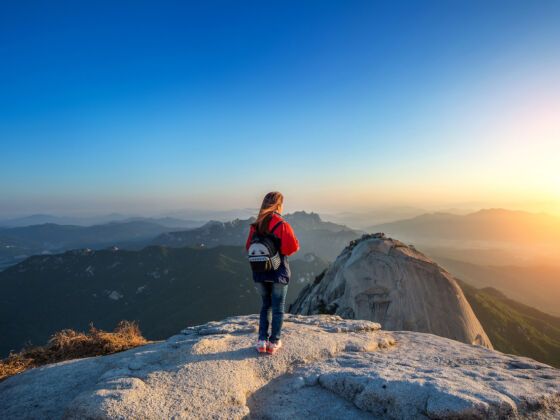
Now that I’ve been in Korea for a while, I’ve come to understand that hiking here is like raving, only better.
Koreans are the most stylish hikers on the planet. Forget high-fashion: K-hikers rock high-altitude style. Back in the mid-nineties in the U.S., we called them techno preppies or gangster ravers: high-performance sports gear, vests, plaid shirts, polar fleece, cargo pants, visors, backpacks (minus the pacifiers, glowsticks and sparkles). Instead of the Running Man, they do the Hiking Man for 8 hours straight and still look like they just came out of the shower.
Koreans hike for 6 to 8 hours, then head to small tents for the after-party. But instead of doing drugs, they do shots of soju and magkeolli (a milky rice wine) in joyous constellations of friends, family, and random dharma bums. Drinking several bowls of pure, uncut magkeolli after hiking all day is one of the best highs in the world. Hiking creates surrogate families, postmodern mountain tribes, linked not by biology, but by the mountain spirits, or San-shin.
Seventy-five percent of the Korean peninsula is covered in mountains. As David Mason points out in his survey of the spiritual landscape of Korea, Spirit of the Mountains, this is one of the few places in there world where mountain-worship, a hybrid of Shamanism, Buddhism, Daoism, and Confucianism, is still practiced. The mountains of Korea have been serenely multicultural for thousands of years, waiting for the rest of the country to catch up.
When you approach the mountain, you see various tribes merge, combine, and then split off on different trails. As you climb a bit, you begin to smell incense and hear trance music in the distance. But instead of Nag Champa and Sasha and Digweed, it’s Buddhist chanting, gongs, drums drifting out of one of the 2000 temples that punctuate the mountainsides.
The chanting and incense blend with the pine-infused mountain air (much healthier than a surgical mask coated in Vics), piercing your lungs and mind, and suddenly you feel alert in a way you never do in they city. Problems and anxieties dissolve.
You become mindful of leaves and trees and clouds and horizons and rocks and smiles and annyeongs. Your mouth tastes clean, your sweat feels warm, you feel connected. People spend a lot of money and waste a lot of time trying to feel this way, and all you’re doing is walking up a mountain with friends or in a densely populated solitude.
At its best, rave culture hoped to tap into something primordial, deep spiritual beats that have migrated from Africa and Asia through Euro-America and back again. Rave culture is alive in Korea, not in the nightclubs, but in the mountains. While there is a desperate shortage of PLUR on the streets of Seoul, there is an abundance of peace, love, unity and respect on the mountains.
Riding the subway home from the mountain reminds me of the bus-ride home from one of those renegade parties back in the day. Some hikers are exhausted and passed out on their backpacks, some still high and chatting and joking and flirting with their friends, some are just dazed and just staring out the window.
Like a good party, coming back from the mountain leaves you refreshed, and a bit cracked out, ready to deal with work, school, or whatever. And after a good long sleep, you wake up, and the first thought that pops in your head is doing it again next weekend.
About the Author
Related Posts
11 Comments... join the discussion!
-
-
I’ve been hiking in Korea for almost a year now. I love it, but it’s quite different than East Coast U.S. hiking. Wilderness areas don’t really exist, and you won’t find much solitude in the forest; hiking here is a very social thing.
Almost every mountain and hill is traversed by trails. At the summit of most hills, people sell everything from ice cream bars to ramen to soju and makjeolli. Some hills have temples and hermitages, and that’s always fascinating.
My only complaint: my legs are always quivering when I’m coming back down the hill; the trail builders here don’t believe in switchbacks.
↵ -
hey seth, i feel you about the legs quivering, i’m thinking about investing in hiking poles. it’s kind of hard to be all meditative about nature when your body is hurting and you’re worried about falling on your face.
i think the farther you get outside seoul, the more peace you have on the mountain. hiking when its crowded, like on holidays, is a real drag. i did it once, and never again.
↵ -
Great article! Im visiting Korea in April and really would love to do some hiking, weather permitting. Do you have any links to hiking groups for foreigners, or recommendations on where to hike?
↵ -
hi kelly, this site is a great place to get started:
↵ -
Awesome post. I love travel articles like this, that get beyond dry info and get straight to the idiosyncratic essence of an experience.
↵ -
that is the best compliment a writer could get, thanks!
↵ -
I think that Koreans like mountains.( I’m Korean)
My parents go to mountains almost every weekend. When they do, it normally takes 6~8hours like you said. They got knackered, but they do love it and look forward to hiking another mountain. They’ve also made lots of friends from hiking.I hadn’t understand why they like mountains before I tried.
It was really tiring, but worth it.I recommend my foreign friends to go to mountain when they visit Korea.
↵ -
hiking is a great bonding experience for families, i love seeing three generations – grandparents, parents, and children all hiking together.
↵ -
I hike almost every weekend in Korea and you’re right on. One element you might not be aware of (but won’t be surprised to hear) is the Korean shock if you aren’t dressed exactly like them. Hike in jeans or, worse, converse and you will be chided at by quite literally hundreds of passing hikers. Some get quite angry. It’s always fun to see though, and it will be weird to hike where people mostly ignore their fellow hikers.
↵ -
thanks! while i love the hiking fashion, i also love seeing the korean hikers who deviate from it, folks in denim, guys who go up the mountain in slacks and dress shoes (and pass me on the trail), ajummas in matching separates, and kids in flip flops and chuck taylors, and have mad respect for the barefoot hikers. they are the true mountain warriors.
↵


