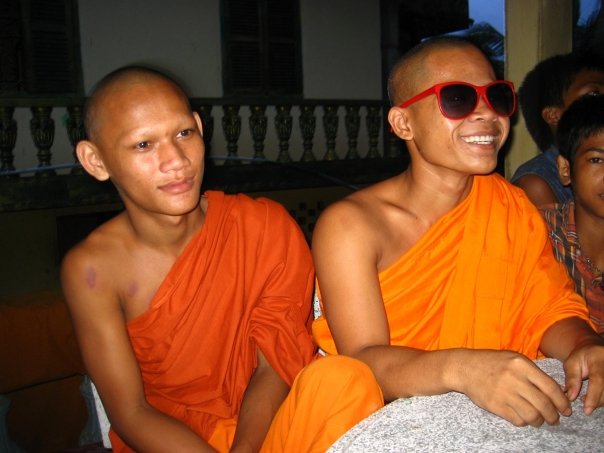

Here in Cambodia, the guesthouse owner, a recent acquaintance, will openly ask if you have diarrhea. Women receive routine injections in their buttocks with family members, friends, and neighbors looking on.
Village medicine.
In America, the hospital is a space entirely dedicated to improving health, almost sacred in its sterilized simplicity.
In Cambodia, IVs are set up under stilted houses with cows in the background and babies are delivered on straw mats in the family home. Personal health is deeply integrated into daily life.
From what I have been able to observe, medicine here is a matter-of-fact business that appears, in my Western eyes, devoid of emotion.
New Questions
More than anything, my research on health care in Cambodia just opened up more questions for me.
I set out with a list of questions I wanted answered. Some of them I found answers to; some of them I didn’t.
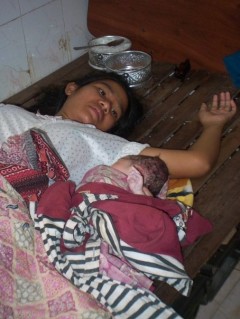
Newborn and mother.
Originally, I wanted to find out the average number of births per Cambodian woman, the cost and availability of pre-natal care and the ratio of female to male healthcare workers in Cambodia.
What I found out was so much more valuable. I envisioned my research taking one path, but it took another and I am glad it did.
My entire experience with the American health care system has been documented, sanitized and monitored. We surround our personal health with such privacy, almost as if it were sacred.
In America, personal health carries a host of emotions: fear, dread, sadness, relief, joy. Not so in Cambodia.
It was not acceptable for a six-year-old girl to cry as her wound was cleaned no matter how much pain she may have been in. A new mother did not smile upon seeing her child for the first time.
Privileged Emotions
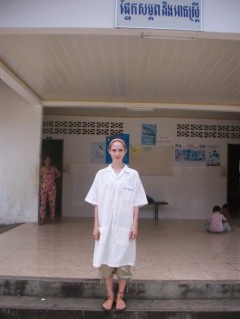
The author in Cambodia.
My research led me to consider emotions in a new way, less as natural impulses and more as privileges. By allowing ourselves to feel emotions, we are indulging ourselves. It is a luxury not everyone can afford.
Americans can afford to be egocentric. We expect a certain level of comfort in our hospitals. People here, I imagine, do not. It’s a cultural necessity.
COMMUNITY CONNECTION:
Are you a student interested in traveling to Cambodia? Check out the Where There Be Dragons summer program Cambodia: Studies in Development and Peace.
About the Author
Related Posts
11 Comments... join the discussion!
-
-
Very interesting, Luisa! I’ve never thought to associate emotions with the healthcare experience. It’s very unfortunate that many of the world’s people can’t expect comfort from their medical facilities.
On a related note, when I was in Siem Reap 2 and a half years ago, I gave blood at that clinic that’s advertised in all the guidebooks. It was actually a more pleasant experience than giving blood in the US!
↵ -
Luisa-
Thanks for sharing your research and travel experiences with us. The opening of the article was really strong and drew me in. The more one travels–it doesn’t matter where, really– the more questions one has. You’d think that wouldn’t be the case– that you’d have more answers! But I’ve always found that new questions arise as the questions we thought we were asking get refined. And that’s a good thing.
↵ -
sometimes I wonder how people in countries such as cambodia survive at all. it’s as though the gov’t is trying to do all they can to not help their citizens. I was complaining to a friend here in costa rica about their public healthcare and she’s like, this is heaven. she lived in china for years and she says they don’t even have any sort of healthcare at all for their people.
The Travel Expert(a) – Living and Traveling Central America↵ -
I love you so much! You are awesome and I will miss you so much next year my college bound beauty!
↵ -
Very, very interesting. And that photo of the mother who looks so detached from her newborn is strikingly haunting.
↵ -
I love this: “By allowing ourselves to feel emotions, we are indulging ourselves.”
↵ -
YIPPEEE.
↵ -
Luisa – you’re amazing! Thanks for sharing your insights with us.
↵ -
Thank you, Luisa. I remember meeting you when you came through the PEPY office in Phnom Penh. I am impressed with your reflections and was at the time meeting all of you – you all had such great questions. As always, impressed with the programs Dragons offers and the students it attracts. Great work, Luisa.
↵ -
Luisa,
This is an amazing article!
↵