Feature Photo: Andrew Currie Photo: akechi
I still remember the sinking feeling I had getting off the train in Guangzhou, China, at 1 a.m. You think that perhaps arriving in the middle of the night in the middle of winter might spare you from the onslaught of shouting pushy people waving laminated fliers, but no.
“Hotel hotel HOTEL HOTEL hotel hotel CHEAP CHEAP good price!!”
The refrain like a cacophony of badly tuned horns, reinforced by jostling elbows and hands grabbing at our coats. These situations require a big deep breath of centered calm. Otherwise, if you’re anything like me, you’re likely to freak out and start running as fast as you can in the opposite direction.
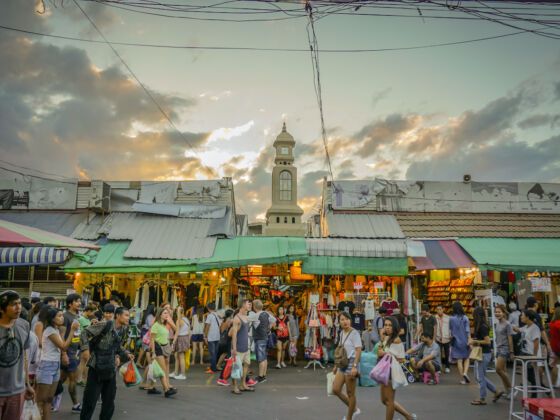
Guangzhou isn’t the only place this happens in the world, of course. At those charged Destinations with a capital D where travelers arrive in swarms with obvious needs to be met (spiritual, commercial, basic, or otherwise) there is inevitably a waiting mass of locals looking to fill those needs, or create them. The Age recently ran a piece about the top cities where you get hassled as a traveler and I can think of many that aren’t on that list.
For me, this is a nasty feeling. I dislike fighting through the crowds, dislike the pulling at my clothes and the shouting, dislike the feeling of being in a full-on, unmasked consumer interaction with a place and it’s people. It’s like pulling that pretty little shear veil of “authenticity” or awe off of a travel experience and a place to reveal the simple, ugly framework of money beneath.
But then again, is it really my place to whine about this? After all, in China or Peru I am taking advantage of the low cost of living and searching out my own version of the authentic (Chinese living in traditional hutongs? Peruvians walking llamas through the Andes?) and there’s no reason the local people need to comply with my vision of an idyllic authentic getaway, right? To many of them, I am a way to make money – perhaps a nice and friendly way to make money or a slightly hostile one, but in any case, a path to the cash. Does this make them bad, cynical, sinister people? Perhaps some, but not all.
From yet another angle, however, one wonders if this sort of unregulated full-on assault throwing all sorts of random goods and services at tourists really benefits the “sellers” or “touts” or “locals” or however you’d classify them in the end – it often creates a popping resentment and hostility between them and visitors, it can end up damaging tourism to the area, and it frequently leads to rampant development in the form of hostels and backpacker joints and, to use a controversial term here, “cultural pollution.”
Yet how do we and they prevent it from happening?
What do you think, readers? Where are the places you’ve been hassled most? How do you deal with it? What do you think could be done about it? Let’s get the discussion going.
About the Author
Related Posts
11 Comments... join the discussion!
-
-
I feel the same way – getting hassled definitely pulls off that veil. I experienced it a lot in Salvador, especially at the Pelourinho, which is the historical district (and where all the music is!)
But every once in awhile, it was something memorable. Once a skinny little boy with a big smile juggled coconuts bigger than his head in front of our table. I hate that that’s what he had to do to make money, but I loved how he much fun he seemed to be having. And I couldn’t help but help him out.
Which is another question I’ve never been able to answer – when it’s a kid, what do you do? If you give them money, are you just encouraging begging? If you ignore them, will they be punished for not earning their share? I had a friend who kept crackers and cookies in her car for the kids who would beg at the lights. She figured that way they get fed, rather then getting money to take back to whoever sent them out there for whatever reason.
↵ -
Exactly. Do not buy things off kids. They are just being exploited. At the Melbourne Cup last year there was this little girl selling yellow rose boutaniers before the gate…her mom was standing at a distance but I went and spoke with her…in a friendly manner of course…to make sure the little girl got to keep the money. I’m generally a trusting (sometimes even naive/gullible) person but I’ve seen enough to be cynical.
↵ -
Kids are definitely the hardest to deal with, in my opinion. I remember being at Chichen Itza and having little kids run up to us holding out crafts and it KILLED me, I had no idea what to do. I like the idea of carrying food, though.
↵ -
I actually wrote a blog post about this awhile ago – http://milesofabbie.com/2009/09/24/how-to-avoid-being-hassled-by-vendors-taxis-and-street-children/
Basically I’ve found that just shaking your head, ignoring them, and continuing walking was the best method for me. I think that you are going to be hassled regardless if you “look” like a tourist, but maybe it’s another reason to explore more non-touristy areas anyway
↵ -
I think that part of the reason that people are “hassled” at airports in touristy cities is that that is how local commerce works. I live on the sixth floor of a building in downtown Santiago (Chile), and I am frequently assailed by the following:
a man shouting, “a mil a mil a mil las alcachofas” (1,000 pesos for the (bag of) artichokes.
the pingapingapinga of a guy on a cargo tricycle selling gas canisters, which he hits with a stick as he pedals by
the whistle of the knife-sharpening guy(some of which I wrote about here: http://bearshapedsphere.blogspot.com/2009/05/donkey-milk-and-raise-your-hand-if-youd.html )
When I go downtown, I’ll hear the shouts of the various newspaper touts, most commonly La Segunda, which sounds like this laseGUNda, and on weekend nights when I pedal past the Plaza de Armas and defacto Peruvian street fair (in Chile), I hear the names of farflung neighborhoods shouted out to the people who’ve come to eat and hang out with friends, this from the mouths of the people filling up passenger vans to drive people back home (and which is not generally done in Chile, this being a little piece of Peru that seems to have come with the people who now call Santiago home).
So I guess what I’m saying is that it may be uncomfortable for us, but a lot of the time “hassling” is heavily culturally-influenced. And it may lack a traditional dwelling or pack animal, but it may, in fact, be 100% authentic.
↵ -
Getting off the ferry on Santorini was something else…they crowd around you like, well, a really big crowd. We had prearranged pick up for a hotel, but they were nowhere to be found. Once the dust settled a bit (when most of the travelers had made their way to their transport) the touts/drivers became very friendly and helped us locate our guy. They all know each other, so someone got on the horn and called him. He was stuck in traffic. So someone else told us to get in his van, which we reluctantly did (what will he want from us?)…and proceeded to drive us up the caldera to a point where the guy who was supposed to pick us up was able to meet us.
So, long story short…I think most mean well, they’re just trying to earn a buck. It might be short-sighted on their part (like you mentioned, could have a negative effect on tourism), but unless you’re in their shoes, it’s quite hard to understand the motives.
I love the touts in Vegas, how they line up on the side and you walk down like you’re on a fashion runway, these guys clicking their pamphlets in front of you (but never really in your face).
↵ -
Love this line: “a full-on, unmasked consumer interaction”
Vietnam is tossed around often in these discussions. Kids selling postcards go around the the backpacker bars in Nha Trang and will NOT leave until you buy one…or you retreat to the hostel. All kinds of things wrong with that.
↵


