Budget Travel in Indonesia: A Revelatory Night On a Ship

08/19/09  Print This Post Print This Post    16 Comments   Popular   Written by Simone Gorrindo
  • Stumble It
  • Share

All photos: author

Traveling on a shoestring gave this traveler a sharp sense of life in Indonesia.
How on Earth did I get here?

The cramped lifeboat, rigged twenty feet above the ship’s main deck, swayed in the afternoon storm.

I had been sandwiched between two families outside when the downpour began. Now, having followed a band of Indonesians up a ladder into the covered lifeboat, I hunched over, trying to calm my stomach as they sang a local pop song led by a badly tuned guitar.
When they finished, the guitarist, a wiry man named Agus, looked over at me and smiled. “You scared?” he asked in English, and the rest of his friends howled with laughter. I tried to laugh with them, but all I could think was: How on earth did I get here?

Windows Into a Culture

Pelni, Indonesia’s government-run ocean liner, had shown up a day late to its destination, leaving throngs of us to a humid night in Bitung’s port.

When it finally arrived the next morning, it took the better part of the day to board its eager passengers—men carrying 50 pound bags of rice on their backs, women lugging crates of goods for export, families laden with children and prayer rugs, all of them pushing against the frenzied tide of passengers trying to disembark.

I could have taken a short plane ride from Sulawesi to Ternate, but I was on a tight budget. And though cheap transport in a developing nation can be uncomfortable, even harrowing, often, the cheaper it is, the stranger and richer the experience. As Rolf Potts puts it, “traveling on the cheap can offer you windows into a culture that go beyond the caricatured stereotype of what a place is supposed to be like.”

During their exploration of Indonesia in the 1970’s, the Blair Brothers spent each night of a 2,000-mile journey in coffin-sized, cockroach-infested spaces below deck of a traditional boat. Their reward? A once in a lifetime adventure with the legendary seafarers of the Bugi tribe.

The Pelni ride in economy class couldn’t match the Blair Brothers’ experience, I knew, but I had a feeling it would give me a realer sense of Indonesia than a plane ride most of its population could never afford.

There are certain travel experiences, however, that life back home can never prepare you for. Once I’d made it onto the liner—a mission that lasted two determined hours— I was hit with a wall of cigarette smoke, the stench of food gone bad, and the worst travel conditions I had ever seen.

As the stream of the incoming crowd forced me along, I stared at the absurd amount of passengers stuffed into the first compartment of economy. I’ll find a cot in the next room, I thought.

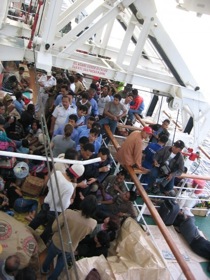
But every room was the same. The cots— vinyl cushions laid out on metal platforms—were all taken, single cushions staked out by entire families. Old men squatted on the cement floor; kids perched themselves on bags of rice, blocking the entryways to flooded bathrooms.

Televisions blared Muslim sitcoms and government propaganda. The heat was unbearable, each room its own kind of cramped village. And they were endless.

“They don’t care about us: they treat us like animals.”

Pelni’s website boasts that “staying in cabin class is as comfortable as a luxurious hotel.” However, as most Indonesians can’t afford that experience, the private cabins are few.

The web site goes on: “sailing is so smooth, one hardly feels a difference to being on land.” That, too, must be a luxury reserved for the cabin class, because the three levels of economy were so far below deck that its passengers might as well have been inside the liner’s rumbling engine.

“Indonesia’s government— it’s inhumane,” Agus, said, motioning his cigarette towards the main deck below us, where hundreds of people crouched in the rain. “They don’t care about us; they treat us like animals.”

In a country as timid as Indonesia, these words were biting ones. After three months of travel throughout the archipelago, I’d never heard the question of humanity mentioned. Most Indonesians carried a hard-earned reticence, in part left over from the days of Suharto’s oppressive rule.

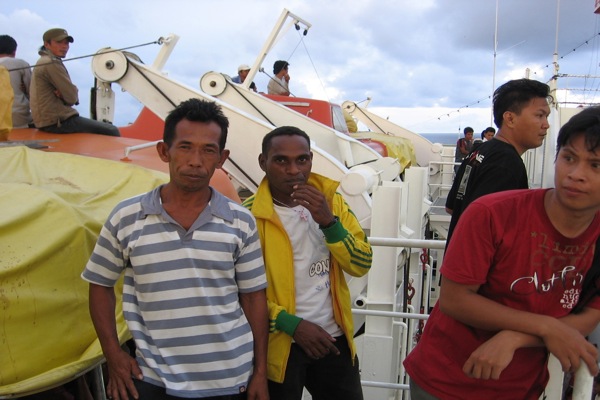
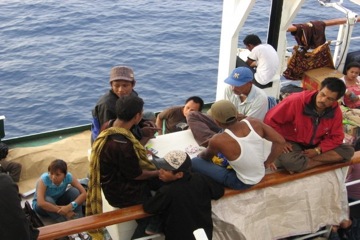
I could see what he meant. I hadn’t found a cot down in economy; in fact, I hadn’t found any space at all. The stairs leading to each level of the ship were a maze of passengers, each landing more impossible to maneuver. The main deck outside looked like a refugee camp, hundreds of families huddled on tarps, men balanced on the ship’s railings playing cards, boys laid out on beams above, baking in the heat.

The most impressive were the elderly, sitting like little Buddhas, patient and serene. Many of these people, Agus told me, were looking for temporary work, others exporting goods. Some of them had been traveling like this for days, even weeks. Agus himself had another four days before he reached Papua to find logging work.

I gazed out through the hard rain at the passengers below. Did they, too, feel abandoned by their government? For me, this was a twelve-hour ride. I could get off this boat and never come back. I could fly out of this country, fly away over its lush volcanoes, its ocean-side villages where floods took homes, and fevers took children, and return to an air-conditioned, carpeted world.

I felt guilty at that moment—not because I had found shelter from the storm, but because for me, and perhaps only me, the storm was a passing one.

Encounters with Hardship

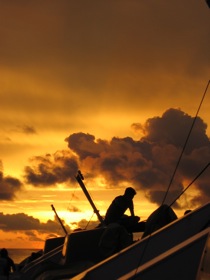
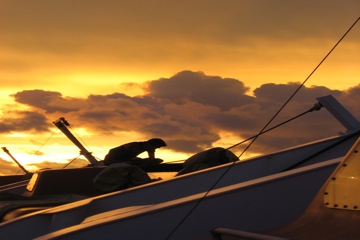
The sunset burned red, filling the sky with its last light. I had surrendered to our precarious shelter, sending my new friends into fits of laughter with my imitations of Sulawesi slang. Now, the storm over, we stood atop the lifeboat. The island of Ternate had finally come within view.

“Photo?” Agus said, pointing to the camera in my pocket. I took it out and snapped a shot of the smiling group. “Thank you,” he smiled, not caring that he’d never see it.

“Terima Kasi,” I said back in Bahasa Indonesia, wishing I had more words to explain. As travelers, we are often drawn to unfamiliar experiences because they open something in us, free us to be stronger, wiser versions of ourselves.

But it was the locals’ grace and humility, not my own, that gave me that freedom. And they learned it from the hardship I only briefly encountered.


  • Stumble It
  • Share

About the Author

Matador ID: SimoneMarie

Simone Gorrindo is a poet, freelance writer/editor, and waitress who has lately bounced between her native San Francisco, New York City, and the outskirts of DC. When she is not writing, she is out traveling, hiking, or dreaming up her next big trip.

16 Comments... join the discussion!

  • Eva replied on August 19, 2009

    Really enjoyed this post! And gorgeous photos.

    (Report comment)

    ↵ Reply
  • Megan Hill replied on August 19, 2009

    great piece, Simone!

    (Report comment)

    ↵ Reply
  • Tim Patterson replied on August 19, 2009

    Lovely article, well-thought out and very well-written. Looking forward to more!

    (Report comment)

    ↵ Reply
  • Michelle replied on August 19, 2009

    Excellent article!

    (Report comment)

    ↵ Reply
  • Indonesia replied on August 20, 2009

    Simone, I would never want to travel in a crowded boat! anyways, can you list a few popular beaches in indonesia. thanks

    (Report comment)

    ↵ Reply
    • Simone Gorrindo replied to Indonesia on August 20, 2009

      Hmmm….popular beaches. I didn’t spend a great deal of time in very touristed places. Bali has awesome beaches for relaxing and surfing, but that’s obviously old news. ;) Bunaken Island, which is right off of Northern Sulawesi, is pretty accessible and has fantastic snorkeling/diving but some of its beaches are heavily littered. Siladen, a small island nextdoor has truly pristine white sand and crystal clear water, but most of its accommodations are resorts.

      Honestly, the best beaches I found were on tiny, remote, sparsely inhabited islands, many of them off of Halmahera, which is pretty remote to begin with. I wasn’t able to get to the Banda and Kei Islands, but if you can, go! Those beaches are supposed to be incredibl,practically untouched, and totally undeveloped.

      (Report comment)

      ↵ Reply
  • Simone Gorrindo replied on August 20, 2009

    Thank you so much for your comments, everyone! It makes me happy to know that you guys are enjoying it.

    (Report comment)

    ↵ Reply
  • Jody Coppock replied on August 20, 2009

    Wow!! Really well-written and thought provoking. Please give us more Simone!

    (Report comment)

    ↵ Reply
  • Fajar Ajie replied on August 27, 2009

    I havent read any outsider perspective that is more incredible yet touching than yours. Truly, you succeed on framing the Indonesian way of life. You earned the firsthand experiences and i salute you for that. not many people would do what you did, and so not many earn the experiences you earned.

    maybe someday you have the time to experience the trans-java train on economic class? you will be amazed. :D
    anyway i’m indonesian and thank you for sharing this wonderful story :)

    (Report comment)

    ↵ Reply
    • Simone Gorrindo replied to Fajar Ajie on August 30, 2009

      Thank you so much, Fajar. I can’t tell you how much your response means to me– made me feel like writing can truly be a worthwhile act. I am touched.

      What part of Indonesia are you from?

      (Report comment)

      ↵ Reply
      • Fajar Ajie replied to Simone Gorrindo on August 31, 2009

        well i hope you keep on writing and inspiring people, simone :D
        i live in northern part of Bandung, about 230 kilometers from Jakarta. One of the best town to lived, especially the northern parts :P
        anyway, thanks for replying my comment before. cheers! :)

        (Report comment)

        ↵ Reply
  • Cynthy Weidemaier replied on August 27, 2009

    Nice job Simone!!!

    (Report comment)

    ↵ Reply
  • C & L replied on September 13, 2009

    Great writing! Personal, thought provoking and inspiring. Looking forward to reading your next piece.

    C & L

    (Report comment)

    ↵ Reply
  • Matija replied on May 17, 2010

    Great article, justi reading it up as i’m planning to go to Indonesia for a month in the summer.
    def. taking some PELNI rides during the travels, so hopefully i find some friendly people to talk to and get a feel of life in Indonesia

    (Report comment)

    ↵ Reply

Leave a Comment

Get Matador in your inbox and around the web.

Sign up for our FREE weekly newsletter.


View full list of RSS feeds

Jump To Category:


Travel Insurance.


Popular Stories on Matador

Mooseheads, Caesars, and Street Hockey: Where to Celebrate Canada Day Outside of Canada

Expats looking for some action this Canada Day, check o... 

7 Really Weird Religions You Haven't Heard Of

The imagination knows no limits, so people will search ... 

Dog Meat and Rooster Balls: The 10 Most Exotic Asian Foods

From Indonesian bats to Taiwanese rooster balls, these ... 

How to be More Comfortable on Camera

Are you camera shy? Try some of these techniques to fee... 

Dating Tips From Around The World

Be careful buying someone a drink in Norway; watch out ... 

VOTE: What Are Your Favorite Things at Home?

Some things at home just can't be replaced. What comfor... 

The Future of Freelance Journalism, Part 1

Notes, quotes, tweets, links and other distractions fro... 

4 Ways to Welcome Your New Baby to the World

Start with these ideas and make them your own. ... 

Surfers and Sport Anglers Speak Out On BP Oil Spill

"We don't know what the future holds, but the beaches l... 

The Educational Value of Long Term Travel with Kids

Extended travel is possible with a family in tow, and i... 


Focus


Editor Blogs