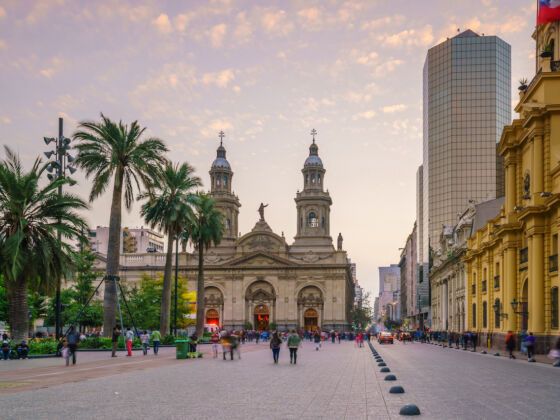
Photo by la_cola_de_mi_perro Feature by hiro008
1. There are plenty of English teaching jobs and internships.
Chile is a great place to work, especially in Santiago where there are numerous English teaching opportunities. Though many adventurers have signed up with an institute before arriving, there are plenty of opportunities to snag teaching positions once you get settled.
A few of the more well-known institutes in Santiago to consider include Norteamericano, Fischer, and BridgeLinguatec.
There are also writing and photography internships available through the English online newspaper, Santiago Times, and its sister paper, Revolver.
2. There are plenty of Chileans and gringos.
The Chileans I’ve met have welcomed me and befriended me quickly, in spite of my inability to understand them or communicate with them very well. They have extended incredible courtesies that I can only hope to repay when they come to visit me.
Photo by Diego.78
On the other hand, everyone needs a little familiarity in a foreign country, and that’s what your ex-pat gringo friends are for. They are the lifelines when Chile becomes a frustrating and intricate labyrinth of cultural cues you don’t understand. Plus, you occasionally need someone who can sing the theme song to the “Fresh Prince of Bel Air” with you.
3. It’s fun learning Espanol-po.
Chilean Spanish takes a keen ear and the patience of Buddha to master. It is filled with modismos, or slang, an accent that lops off the ends of s’s and d’s, and a new way to pronounce the “you” form.
In spite of the challenges, it can delight you when you least expect it. For example, the word for boyfriend is pololo, which means a type of small fly that buzzes around your face. What a word!
4. Chile has diverse terrain to explore.
Photo by hiro008
Why visit a bunch of different countries when you can see everything in one? Chile’s got it all. Visit the Atacama Desert, ski the Andes (the longest mountain range in the world), surf the Pacific Ocean, walk the forests around the Lake District, catch a glimpse of a glacier in Patagonia, or climb volcanoes and paddle world-class rivers in Pucon.
Photo by hiro008
5. Chile’s hot…and cold.
The Andes run down the eastern side of Chile and are home of some of the best skiing in the world. From Santiago, you can take a weekend trip to Portillo, the practice site for many professional skiers.
Two hours outside of Santiago to the west are beaches. There are some of the biggest, most uncrowded points for surfing on the whole Pacific coast, as well as chill beach towns.
6. Santiago’s art and culture.
Photo by Claudio.Núñez
Not only does Chile’s capital have an incredible set of museums like Bellas Artes and the Pre-Columbian, it has a vibrant street art scene withnew murals and graffiti as well as events like those put on by Mamut Collective Theater. I highly recommend their Teatro de Gorilas, an improv show much like Whose Line is it Anyway?
7. Who can resist an Independence Day celebration that lasts a week?
Photo by >Voj>
Chileans celebrate September 18, their independence day, by staging a week of fondas (street fairs), where you can play games, eat lots of food, and watch the cueca, Chile’s national dance.
After the fonda, you will most likely head to someone’s house for a fiesta that lasts until the sun rises. Then, you’ll go home to sleep it off and get up to start it all over again.
8. Chile has a stable economy and government.
Chile’s stable economy and government make it a good choice for solo travelers, especially women looking to move to a South American country on their own. Certainly, there are dangerous areas of any country, and Chile is no exception, but a gal on her own can get along very safely here.
<
9. Ice Cream.
Places like Emporio la Rosa and Bravissimo can become a favorite corner of the world for the foreigner in Santiago. With flavors like nueces (walnuts), miel (honey) and manjar, you won’t want to return home.
10. For all the familiar, Chile still feels foreign.
For all its safety, Chile is still a foreign country. From having to throw your toilet paper into the trashcan by the toilet to the water heater that must be lit every day to take a shower to the stray dogs wandering the streets, Chile is nothing like home. And that makes it all worth the adventure.
COMMUNITY CONNECTION
Headed to Chile? Read up on the country’s 8 Natural Wonders, or check out this guide to Trekking Torres del Paine.
About the Author
Related Posts
5 Comments... join the discussion!
-
-
Thanks so much for the clarification Gabriel. I'm fascinated with the origins of words in both English and Spanish and find your comment is a great addition to what I wrote. Although I've read that pololo is a Mapudungun word for fly, instead of honeybee, I hope your version has more weight. Makes the word pololo much sweeter.
↵ -
My bad… It refers to FLIES not honeybees. Guess that's the magical realist in my Chilean blood!
Here is a good etymological explanation: ” target=”_blank”>http://etimologias.dechile.net/?pololo
↵ -
I loved it. specially the part about how we speak. It´s true we can´t do without our muletillas (words someone tends to use a lot even though they are not necesary).
Even though Chile might be a great place to visit, and to learn about a new culture I don´t believe it’s great for college exchange students. I get a lot of gringo classmates every semester and it sucks to see how much they struggle to understand classes. The teachers usually speack to fast for them to understand and use to much slang. So unless they already know how to speak kinda well, it´s hard to keep up with classes.
Oh yeah.. here you can get a meal for only mil (1.000) pesos. Funny thing is that mil and meal sound the same if you have an accent
↵


