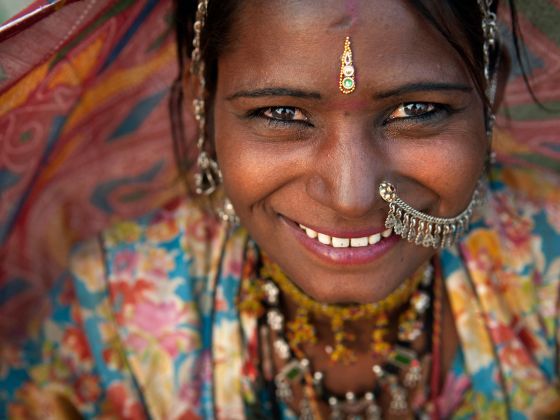
Lajpat Nagar by Wili_hybrid
For ages, India has been viewed as a symbol of the mystical and exotic East.
Dismissing India as a cliche runs the serious risk of placing India in a timeless zone outside of the real world, which is increasingly modern and complex.
India is a vast and rapidly developing country with twenty-eight different states and seven union territories. India hosts a great many languages, religions and cultures, which coexist and intermingle.
Delhi sunset by Wili_hybrid
The real India is hardly the random (yet homogenous) assortment of the Taj Mahal, call centers, poor people and veiled women you might expect.
The India you’ll actually encounter is a lot more diverse and complicated than that. Things are changing in India at a frenetic pace, especially in the big cities.
Hopefully, these tips will give you a better understanding of what to expect when you travel to India.
Sacred cow by Wili_hybrid
Temple Etiquette
Always take your shoes off before you enter a place of worship in India, and do not wear revealing clothes.
Travelers in India are often tempted to wear shorts, but it’s crucial to keep your shoulders and the lower part of your body covered when visiting a site of religious importance.
As the land where four major religions originated, and many others arrived and never left, many Indian people take their religion very, very seriously.
If you are interested in exploring their religious sites – many of which can be of immense historical and archeological importance – please respect religious sentiments even if you are not a believer.
Street scene by Wili_hybrid
Prepare to be OVERWHEMED!!!
India carries the burden of three centuries of British imperialism, along with the weight of its own often reworked and redefined history.
Destinations
The two make a very postmodern combination. The complications and contradictions of India’s political realities will stun the first time foreign visitor.
You’ll encounter huge, swanky shopping malls very close to massive slum settlements that reek of utmost poverty.
Many visitors who stay in India leave with a sense of accomplishment, after having survived the initial overpowering shock.
And rest assured: it is a shock to learn what it means to live in India (as over a billion of us do).
Public Displays Of Affection
The beautiful lagoons of Kerala or the beauty of the Taj Mahal might make you want to sidle up to your partner and give them a quick hug and kiss, but think twice before doing that in public.
Even though you might catch young couple canoodling in public parks, it’s best not to perform public displays of affection in India.
Sexuality and Women Travelers
White women traveling in India may feel very vulnerable and exposed to some of the Indian men that they might encounter.
Due to some cultural constructs, and also a great deal of curiosity, Indian men might have formed certain false notions of the sexual availability of the foreign woman.
I am not saying that every other Indian guy you meet will be a pervert, but street sexual harassment is a phenomenon that is unfortunately widespread in the country.
You might fall prey to this due to your increased conspicuousness. It’s best to dress conservatively and keep yourself safe at all times.
Don’t forget the basic safety rules you’ve learned in your own country, and also observe the way the local women dress and behave as an example.
Hands and Feet
Hand by Meanest Indian
There’s a whole hierarchy of the body parts in Hinduism. The head is superior to the rest of the body, and the feet are lowest on the rung.
Feet are considered dirty in India, so take off your shoes before you step into someone’s house. Don’t step on anything important and if you do, immediately express your apologies.
It’s a sign of deference to bend down and touch a respected elder’s feet in India.
The left hand is customarily used for cleaning oneself after defecation, so Indian people never eat with their left hands. Also remember never to pass on anything – money or a gift – to an Indian with your left hand. The most conservative Indians might take offense.
Questions and Eyes
Bow Down by Koshyk
What might be considered intrusive in many Western cultures is only a matter of course in India. Also, people will generally be very curious about foreign visitors, and this can take the form of unabashed staring.
There’s a lack of privacy among the teeming millions of India, and the concept of personal space as you know it might not exist.
Try not to take it too personally if people on the street seem to be staring at you all the time, and if Indian acquaintances and friends ask you questions that you think are none of their business.
Most of the time, it’s just friendly curiosity, and if you smile at a staring stranger, many times you will get an amicable smile back. However, never sacrifice safety for the sake of politeness. This is especially true for women travelers.
You’ll Be Hounded
You might be seen as a rich foreigner thanks to the exchange rate, and many times you’ll be followed around by beggars, beckoned into shops by over-eager store keepers, and hailed by expectant taxi drivers.
Make sure your local friends tell you what the standard rates are, because if you’re looking to do some great shopping or have a comfortable public transport experience, you need to be in the know.
Holi festival by faceme
Indian Festivals
With so many religions and cultures, you will come across fairs, celebrations and merrymaking of all kinds.
Whether it is the shimmering lights of Diwali, the colors of Holi, the extravaganza of Durga Puja, Navaratri, Onam, Dusshera, Id Ul Fitr and Christmas, you’ll encounter indigenous customs, amazing Indian cuisine and total festive abandonment.
We Are Like This Only
English is widely used throughout the Indian subcontinent, and is the “co-official” language of the country. Indian English has a distinct flavor and inflection that differs as you travel around different parts of the country.
Official Indian English often uses many phrases that are passé in the West, so don’t be surprised if you’re doing some paper-work and someone asks you to “do the needful”.
COMMUNITY CONNECTION:
Other excellent articles by Shreya Sanghani include:
Photo by Wili_hybrid
Calcutta Nights: A Guide To Live Music and Discos
India’s Pink Chaddi Campaign
India’s Up And Coming Rock Scene
Also be sure to read Can You Develop Your Spirituality Without Visiting India? by Matador’s resident yogi, Christine.
Namaste!
About the Author
Related Posts
27 Comments... join the discussion!
-
-
Thanks Julie, my friend and I were talking about this recently – she is Indian and was just back from a trip to Rajasthan. She expressed a lot of frustration at some of the brochures and guide books she had seen – it’s a touristy gimmick to promote India as being about only certain things. But the supply feeds a demand — a lot of travelers love these stereotypes and the whole thing just spawn an extremely inauthentic Indian experience, in my opinion.
Also (running the risk of generalizing too much myself) many Indian people ARE generally fond of cricket and Bollywood.
↵ -
I wish I had read this about a month ago. I learned most of this the “hard way”, although it wasn’t really that hard. Thanks for not explaining why to eat with the right hand and not the left…
↵ -
Sorry Tom
that’s the “traditional” interpretation I’m afraid — How much of India did you see?
↵ -
I’m still too intimidated by the image of India I have in my mind–so big, so busy, so beautiful–to attempt a visit. But I have no doubt I’ll make it there one day, and when I do, I’ll be sure to revisit this article.
↵ -
I hope you do, Hal
↵ -
You should really come back and see more of India sometime though
↵ -
Uh oh, I’m going to have to practice with my right hand before I go to India (I’m left-handed!)….
↵ -
Colin, I’m left handed too! I had the whole “eat-with-your-right-hand” thing drilled into when I was little. I still write with my left hand, though I’m nearly ambidextrous otherwise. I distinctly remember this one vendor on the street refusing to take money from me because I was offering it with my left hand. It’s not always so strict though. I often leap off autorickshaws (known widely a tuktuks, I believe) when I’m late for college, without thinking about which hand I’m using to pay the driver with.
↵ -
I’ve been wanting to go to India for a while now…we seem to put it off because we want to have a good amount of time there, so waiting until that day. Especially after reading Shantaram, which took about 2 years to finish.
Thanks for the insight Shreya!
↵ -
My pleasure Carlo — and just send me a message when you are coming here and need any information.
↵ -
How do you think the British and reworked/redefined Indian history effect contemporary political realities in India? What did the British do to triple the Indian population in the past 60 years?
↵ -
Hi Tim,
British Imperialism brought about a lot of changes – both positive and negative — to India’s political and social reality. While I am hardly an expert, my study of this subject may well give rise to some observations which I hope are relevant.
Let me give you some examples. The present Indian system of law is completely based on the British model. There existed a system of law prior to this, which is completely discarded. While there are a lot of advantages to this system of law, there are also great costs incurred in the loss of the original system. The present Indian schooling system also originated with the British. The railways – the largest in the word – were brought by the British. T S Eliot in England first suggested the teaching of English in Universities – this subject was not taught at universities until 1900 – and English was first taught in India as an experiment. The British set up major universities at places like Calcutta, Bombay and Chennai. The traditional practice of sati was abolished, which to me is a fantastic thing. The Brahmo Samaj was formed, and was influenced by Europeans. The English language itself was a very positive thing – in some respects – to have happened to India. There were many wonderful Britons who came here and did some great work.
Every time a country is ruled by another, Tim, there are advantages and disadvantages working at many levels on both sides. The British rule of India is no different. I’ve already cited some positive examples for you, now let me cite what might be perceived as negative – because of the British, the indigenous handicrafts industry was pushed out of the mainstream and till date, remains in the sidelines. The hierarchy of languages is such that English must be known and spoken in order to obtain a so called “respectable” job especially in urban India. There are no computer programs in any of the vernacular languages in Indian educational institutions, indeed the vernacular languages do have less of a currency than English. The cultural divide between Britain and India at the time of colonization was such that much of original Indian music, culture, arts and sciences and other disciplines lost out due to imperialism. One of the biggest political problems in India today – the strife between the Hindus and the Muslims – was first observed only after the British came to India. Prior to this, the Hindus and Muslims did not have major conflicts in the 1000 years of coexistence that they shared. Today, riots and endless warring over Kashmir are big political features. The partition is a big scar that both nations of India and Pakistan have had to endure. And I haven’t even talked about Bangladesh here. These are very tangible examples, and there are a other, more intangible ones which I will illustrate for you if you want.
↵ -
I have not mentioned anywhere in my article that the British contributed to the population explosion in India, so I don’t know the purpose of your second question. It may well be that you have perceived my comment in the artlce with regard to British imperialism as being pejorative. This is not true. Valorizing one culture does not have to mean demonizing another. Indeed, I am a child of this colonialism, and both these cultures are my own. Yet I am Indian. The past is dead – history is fluid – the value systems that made one thing moral at one point in time have completely changed. What made sati and Imperialism moral three hundred years ago, has changed and these things are unbearable now. What I’m trying to say, Tim, is that we must move on from the past. Yet we cannot disown it. It is a part of us, it shapes us, we cannot disregard it.
It would be juvenile to say that Imperialism did only good things, or only bad things for both India and Britain. Hence we cannot connect population explosions directly to any one historical phenomenon, any more than we can say that it is right and fantastic to disregard one culture completely for the sake of another. I do not wish to descend into jingoism, and I don’t think I have.
I’d like to finish by telling you a little bit more about India – which is what this article is about in the first place – India is a pluralistic nation. It is about as big as Western Europe. The difference between Gujarat and Bengal is much vaster than say, England and France. I am in one place in this vast country, speaking from an urban setting. There is a vast divide between the urban and the rural in India. The country is now witnessing its 15th democratic elections. The very country whose population has tripled over the last few decades, produced singlehandedly 25 per cent of the world’s total produce in terms of GDP. India is too complex – just like any country is too complex – to have its political and social realities be defined by something as fluid and subjective as history.
Some people will tell you that Isaac Newton did not invent Calculus. It was invented in Kerala 300 years before Newton. Pythagoras did not create or solve the Pythagorean theorem. It was solved 200 years before Pythagoras by Indian and Chinese mathematicians. Yet none of this is taught in Indian classrooms.
There is something about colonialism that serves to wipe out regard for indigenous cultures. That is a shame, I think.
I reiterate Tim, that I did not mention the British in a negative manner. I think British imperialism has done both great and terrible things to every country it has manifested in, including India. Thank you.
↵ -
Thank you for your reply Shreya!
I was wondering about the population explosion because with 0.4 billion people instead of 1.2 billion “massive slum settlements that reek of utmost poverty.” would be reduced. How could England have made India more like China? What do you think the increased population and decreased GDP of India compared to China is due to?
↵ -
Hey Tim, yeah it is true that lesser people would translate into lesser numbers of poor people in a developing country. However the same thing would possibly be a plus in a country that’s already developed. One way of looking at the population explosion is that fewer people die because of better medical facilities. This happens with increased technological advances which were put into practice by visionary Indian leaders such as Nehru and later politicians.
There are also many immigrants coming from neighboring countries adding to the existing population. Poverty and illiteracy also lead to people who have larger families, which in turn lead to other problems such as increased child labor, etc. It’s a cycle. As to how England could have “made India more like China” I am unequipped to answer. I’ve already expressed my skepticism about making these direct uni-dimensional connections. From whatever little I know of history, China had a pretty effective family planning policy that was strictly enforced. Also, China was not colonized as a whole I think — only parts of it, and different parts were under different spheres of influence.
Also I’d like to add one point to my earlier comments. I’d like to give credit where it’s due — the work of Indian feminists such as Raja Ram Mohan Roy was greatly responsible for the abolition of sati. Should have mentioned him. It was definitely an amazing thing to have done — stand up against extremely conservation values and oppose them especially during those times.
↵ -
conservative values, not conservation values. Forgive me.
↵ -
Hey Shreya,
take a bow!!!! It makes me wish I had written it!!! Bravo!!! And at 19!!!! Well written and definitely a pleasure to read.
↵ -
thank you so much, it’s an absolute pleasure
↵ -
I’ve always wanted to go to India, I’m fascinated by it but I’m unsure what I should see first, any suggestions?
↵ -
Hi Shreya,
Its definitely a nice and brief introduction about India to Foreigners. You indeed done a great job, with great matuarity.
Hi Tim,
(no offense to you, I record my perception here – that I believe as of today fully, I do NOT claim that everyone in this world have to accept/agree with my thinking)
I am an Indian and agree with Shreya, that we Indians witness both Negative and positive impacts from British Raj. However we do NOT consider every present good and bad of India have direct link to British raj. . . . I personally do not think population is a problem for India. . . . the problem for India is to provide basic education, food and health for people… and that can only happen when we can fruitfully engage our human resources for value creation much bigger than they consume… the day we achieve this the whole world see India with great respect… I know its a long drawn task… but it will possible by joining creative and active participation of our own people…..I am hopeful that we will do it… we are working it in our own way, and in comings years and decades many more with join in Nation building….we all know Japan was devastated after 2nd world war, but with great populations its still win the prestige of the world… that gives indication population is not curse, but utilized rightly it can make India proud. There are many examples around the world who do not have enough talent (read population too) to extract value fro their country. They are doing everything to bring top professionals from developing countries like India, China and many others to make TAX money (from corporate profits by doing more innovation, more business & earning more Individual Tax) for their pension system for their aging population Some major power will crumble if all Indians & Chinese decide to go home and use their knowledge, skills and talent for their own nation. – my point is population itself is not India’s or China’s problem, problem it how we as a nation create more value than we consume …
I am positive India and China will shine some day more than any other country in the world. But that do not happen in a day….both are countries have different history, different present and different future growth path with different goods things and different bad things, …. so they are not comparable.
There was a time when British Rule the almost all world, and they think they can continue doing that….but time have proved that’s not true…..when America took the power and British hide behind the shadow of America, by becoming friend….now its time have come America will lose control on the world…. although its looking good for India & china in mid or long term, but history told us, nothing is constant…but change it.
↵ -
Very well written Shreya. Hats off to your analytical skills and clarity of thoughts at tender age of 19. I am based in the US for past 8 years and am planning to visit India (Gujarat) in November of this year. While reading about ‘current’ India – your article came up online. Thoroughly enjoyed reading it and of course your comments. Keep it up!
↵ -
My sincerest thanks to everyone who left comments. It’s such a pleasure to read them!
↵ -
Hi Shreya,
I’m off to India next month.. any tips on the situations in India at the moment. Anything new I should know?
Thanks for a great article!
↵


